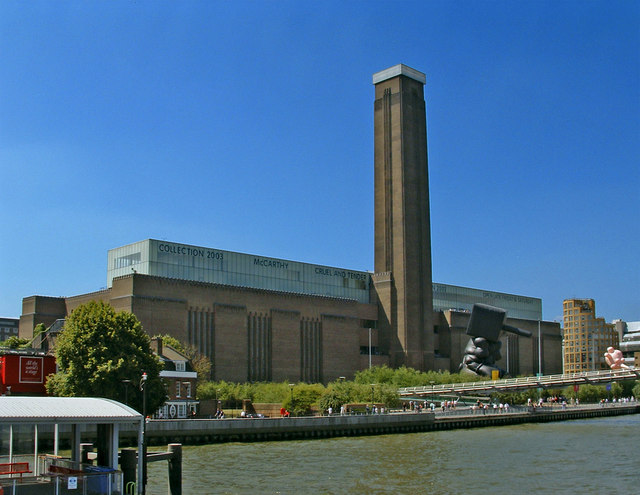
There are artists whose exhibition you visit, and others whose life you walk through. With Tracey Emin, the distinction does not exist. The Tate Modern has dedicated a retrospective to her, running until 31 August and titled “A Second Life”, and the title says it all. This is not a reckoning, it is a resurrection. More than a hundred works span four decades of a practice that has never stopped placing the body at its centre. Her own body, as a territory of truth.
I walked through the galleries on a weekday morning, when museums still have that quality of silence that allows you to listen to what the works are trying to say. And what Emin has been saying, all along, is that there is no difference between living and creating, that art is not a commentary on existence but existence itself, laid bare, exposed without the safety net of aesthetics.
You enter through the early works, those of the nineteen-nineties, when the London art world discovered with a mixture of fascination and disgust this young woman from Margate who refused to separate her intimacy from her work. “Everyone I Have Ever Slept With 1963–1995”, the tent embroidered with names, is no longer there, destroyed in the Momart warehouse fire of 2004. But its absence is as eloquent as its presence ever was, as explored in seeing differently.. Emin has always understood that loss is part of the work, that what disappears continues to haunt.
Then there is “My Bed”, of course. The unmade bed, the crumpled sheets, the empty bottles, the stained underwear, the cigarette butts. In 1999, when this piece was presented for the Turner Prize, the British press erupted. This is not art, they said. It is dirty laundry. But that is precisely where Emin’s radicality lies. She does not represent despair, she shows it. She does not paint depression, she exhibits its material traces. The bed is not a metaphor. It is a bed. The one in which she spent several days without eating after a breakup, surrounded by everything that constitutes the ecosystem of a collapse.
Twenty-seven years later, standing before that same bed in the clinical light of the Tate, something has changed. The object that once scandalised has become a monument. Not because time has softened its charge, but because the world has finally understood what Emin knew from the start. Vulnerability is not a flaw, it is a form of radical courage.
The neons fill an entire room, and it is perhaps here that the exhibition reaches its greatest poetic intensity. Those sentences written in pink, blue, white light, in Emin’s own cursive handwriting, trembling, personal, like words scrawled on a wall at three in the morning. “You Forgot to Kiss My Soul”. “I Can Feel Your Smile”. “Just Love Me”, as explored in Venice Biennale 2026.. There is in these neons a magnificent contradiction between the fragility of the message and the permanence of the medium. The light does not go out. The words keep glowing even when the pain that inspired them has eased.
But the revelation of this retrospective, for me, is the recent paintings. After her cancer diagnosis in 2020, after the operation that saved her life but took a part of her body, Emin returned to painting with a new urgency. The canvases are large, gestural, often rendered in muted tones, flesh pinks, browns, blacks. The bodies she paints are her own, always, but a self transformed, scarred, rebuilt. There is in these late paintings a freedom the earlier works did not possess, something that comes from the other side of fear.
I stood for a long time before a large untitled canvas, a reclining body, legs open, painted in broad and imprecise strokes. The face is barely sketched. The hands have no fingers. And yet this body is more present, more alive, more embodied than any academic nude. It is because Emin does not seek resemblance. She seeks the truth of the gesture, and the truth of the gesture is that it does not turn back. What is laid on the canvas stays. What is lived in the body stays. There is no pentimento.
It is here that I feel close to her, in this zone where the gesture is irreversible. When I work in black on white, when ink meets paper or acrylic bites into canvas, I know I will not get a second chance. The mark will be what it is. It will carry my fatigue or my momentum, my certainty or my doubt, but it cannot be erased. Emin paints the way one lives, without a net. And it is this absence of a net that gives her work its incomparable emotional charge.
The exhibition ends with a room devoted to her writings. Letters, private journals, short texts published or not. There you discover a woman of sharp intelligence, funny at times, always clear-eyed about herself and the world that watches her. She wrote somewhere that she does not make art to be loved but to be understood. The distinction is immense.
Leaving the Tate, I walked along the Thames. The London sky was low and grey, that flat light that makes everything sharper, truer, like a natural black and white. I was thinking about what it means to devote your life to hiding nothing. To showing the unmade bed, the wounded body, the love words you regret, the scars you cannot cover. It takes a specific kind of courage, a courage that has nothing to do with bravery and everything to do with acceptance.
Tracey Emin is sixty-two. She paints. She writes. She continues to tell the truth with a stubbornness that commands respect. “A Second Life” is not merely a remarkable exhibition, it is living proof that the most powerful art is born when you stop protecting yourself.
The Tate Modern presents “Tracey Emin: A Second Life” from 26 February to 31 August 2026, Bankside, London. Paid admission, free for members.