There is an hour of the day that belongs to no one. Six in the morning, perhaps a little before. The streets are empty, the sky has not yet chosen its colour, and the air carries that peculiar density of things not yet begun. This is the hour when I push open the studio door.
The key always turns a little stiffly in the lock. I never have it fixed. That small moment of resistance, that second when the metal hesitates, is already a kind of threshold. You enter a different time. The outside world with its urgencies, its notifications, its obligations, all of it stays behind, on the other side of that creaking door.
The smell greets me before the light does. Turpentine first, that sharp vegetal presence that saturates everything, the walls, the fabrics, my clothes. Then acrylic, more muted, more chemical, mingled with pigment dust and the wood of fresh stretcher bars, as explored in the irreversible gesture. India ink is more discreet, almost sweet when you uncap the bottle. My studio smells of work, and I know no scent more comforting.
I never begin by painting. There is a ritual, and this ritual is sacred because no one taught it to me. It built itself, gesture by gesture, morning after morning. Coffee first. The Italian moka pot I set on the small burner in the corner, the sound of water rising, that gurgle that sounds like a conversation between two old friends. I pour the coffee into a bowl, never a cup, because a bowl is held with both hands, and I need that warmth in my palms before I touch anything else.
Then I look. I sit before what I left the night before, and I look the way you might read a letter written by someone else. That stroke I laid down yesterday, that current of black that dried into cracks I had not anticipated, that zone where the white of the support still resists, intact, almost defiant. The painting in the morning is never the same as the painting at night. The grey light of dawn lends it a new gravity, something more honest. The contrasts are less dramatic, more true. It is at this hour that I truly see where I stand.
There are mornings when the canvas frightens me. Not the fear that paralyses, but the fear that precedes the leap. This vertical format I favour, sixty by ninety centimetres, rises before me like a body standing upright, and I know the next gesture will be irreversible. Acrylic does not forgive, as explored in painting beyond photography. Neither does ink. There is no pentimento when you work in black and white, no colour to come and soften the error, no varnish to erase what disturbs. Every mark remains, and that is precisely why every mark matters.
I prepare the brushes. The wide ones first, the ones that serve for flat washes, for sweeping gestures, for decisions. The finer ones will wait. I take out the tubes of black, always several blacks, because they are never truly black. One leans towards blue, another towards brown, a third is so dense it swallows light like a void. White, on the other hand, is singular. White does not lie.
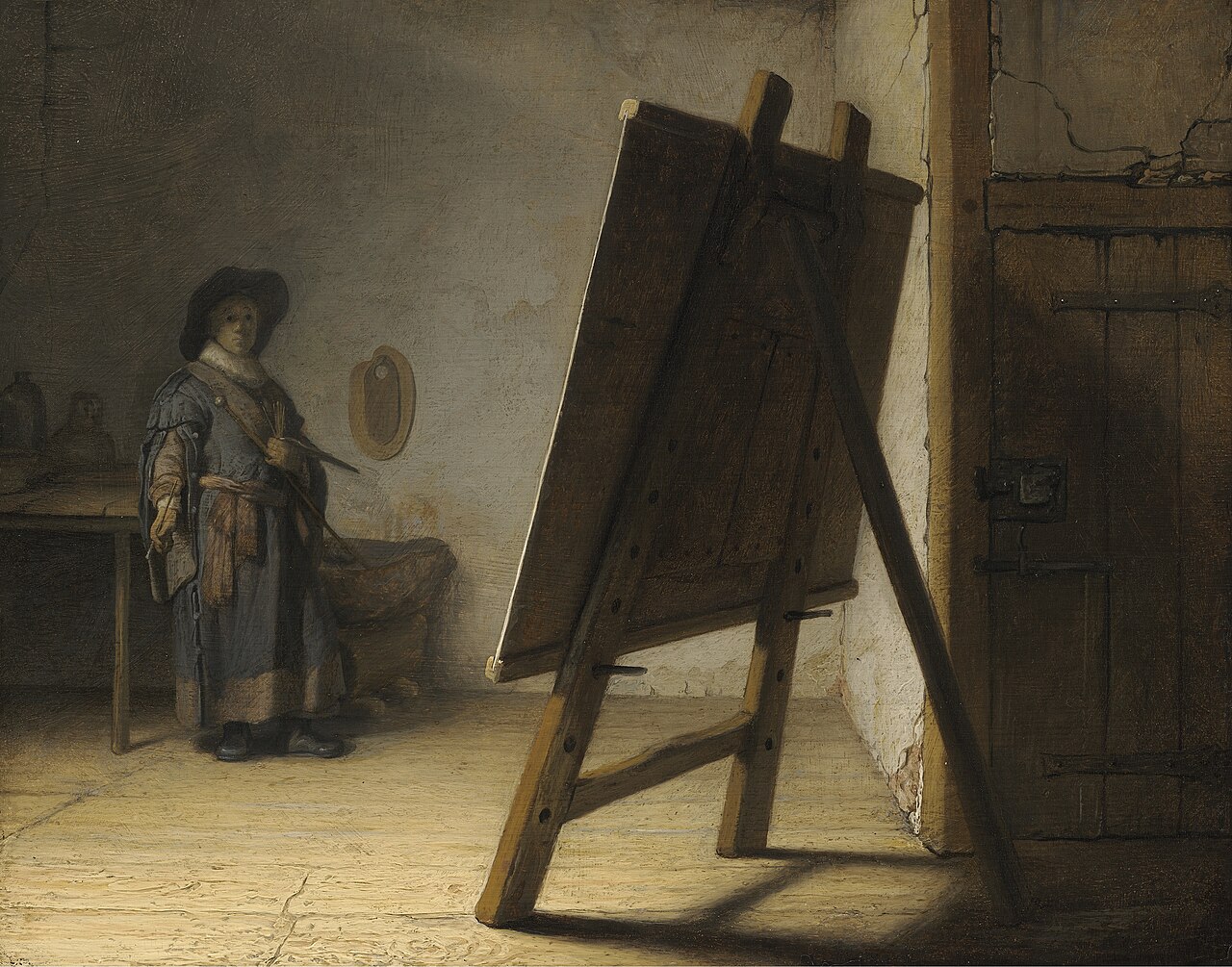
The water in the jars is clean, transparent. It is a fleeting luxury. Within an hour it will be grey, then black, and the jars will resemble small stormscapes. But for now, everything is clear. The tools are in order. The floor is stained but swept. The blank stretchers are stacked against the far wall, waiting their turn with the patience of things that know they will be called upon.
The light shifts as I prepare. It is imperceptible at first, a slight warming of the grey, a hue passing from lead to pearl. Lyon offers this to early risers, that in-between palette, neither night nor day, a suspended space. The studio window faces north, which means the light will never be spectacular but will always be steady, always reliable. That is exactly what is needed for working with contrast. Northern light does not lie.
It happens that I linger in this silence of the before. The neighbourhood wakes outside, I hear the first sounds, a metal shutter being raised, an engine, footsteps. But inside the studio, silence has texture. It is a full silence, inhabited by every canvas in progress, every suspended gesture, every decision yet to come. I often think of that phrase attributed to Agnes Martin, about the best state for painting being an empty mind. I do not know if my mind is empty at six in the morning. It is more like washed, rinsed by sleep, cleared of noise.
When I finally dip the brush, when black touches the surface for the first time that day, something happens that cannot quite be explained. An accord, an alignment, a physical sense of necessity. The gesture is not thought, it is prepared by everything that came before: the ritual, the waiting, the silence, the coffee drunk slowly. The arm knows. The body knows. The mind, at last, falls silent.
It is for those first minutes that I rise so early. Not out of discipline, not out of virtue. Out of hunger. That moment when turpentine fills the air, when the black is fresh, when the light is grey and soft, when no one is watching, is the freest moment of my life. The painting is not yet judged by anyone, not even by me. It exists in a time before words, before categories, before the gaze of others.
Everything I paint later in the day will carry the imprint of that first hour. Like a fundamental note upon which everything else is built.