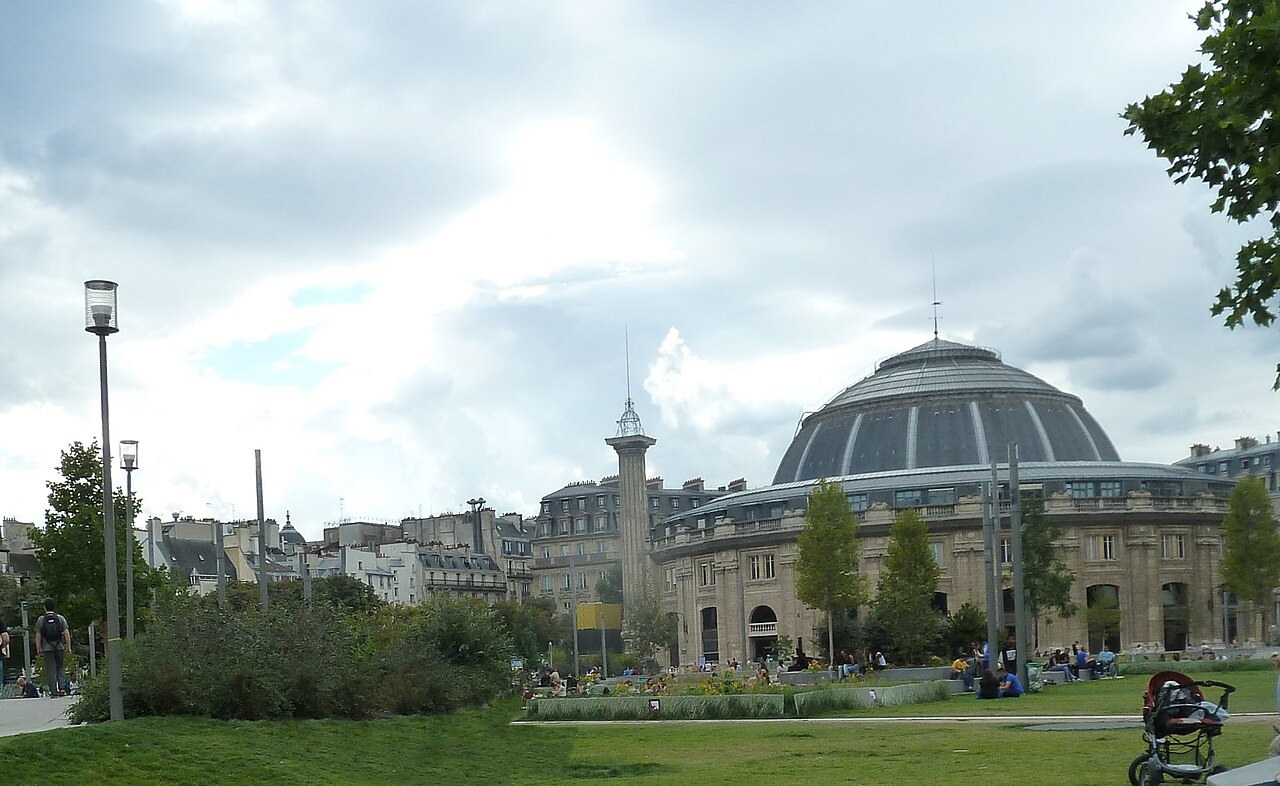
You enter the Bourse de Commerce through the light. The glass cupola, restored by Tadao Ando with that Japanese rigour that leaves nothing to chance, floods the rotunda with an almost unreal brightness. And it is precisely in this light that Francois Pinault has chosen to install an exhibition devoted to its opposite: shadow. Clair-obscur, open since March 4 and on view until August 31, 2026, is one of those rare exhibitions that do not seek to demonstrate a thesis but to create a climate. You walk in with your eyes. You walk out with your body.
Black as Presence
The journey begins with Giacometti, and the choice is unerringly right. His threadlike figures, those emaciated silhouettes that always seem on the verge of vanishing, occupy the space with a paradoxical authority. The thinner they are, the more present they become. Giacometti never painted black — he painted with grey, with scraped matter, with absence, as explored in the irreversible gesture.. His bronzes, beneath the cupola of the Bourse, catch the zenithal light and transform it into shadow. Every viewing angle reveals a different silhouette, as though the sculpture refused to settle into a single form.
A few metres away, Dubuffet explodes. Where Giacometti whispers, Dubuffet roars. His texturologies, those surfaces teeming with raw matter, function like lunar landscapes seen under a microscope. Chiaroscuro in Dubuffet is not a matter of directed light: it is a battle of textures, a clash between crust and hollow, between what catches the light and what swallows it. One thinks of the walls of Paris, of cracked pavements, of everything the civilised eye refuses to see and that Dubuffet scoops up with savage relish.
Bruce Nauman, or Darkness as Material
The room devoted to Bruce Nauman may be the most unsettling in the entire show. Nauman works with black not as a colour but as a condition. His blinking neons, narrow corridors, looping videos create a space where the viewer loses all bearings. You no longer know whether you are looking at the work or the work is looking at you, as explored in Klimt in Rome.. Chiaroscuro here becomes literal: the light comes on, goes off, returns, vanishes. The visitor’s body is caught in a rhythm that is not its own.
It is a physical experience. Nauman does not address the intellect — he addresses the nervous system. In one installation, a corridor so narrow you must advance sideways, the raking light projects the visitor’s shadow onto the wall, warping it beyond recognition. You become your own chiaroscuro. You understand, in that second, that the subject of the exhibition is not light. It is us.
Bill Viola and Wolfgang Tillmans: Two Ways of Breathing
Bill Viola slows everything down. His videos, projected at monumental scale in one of the side rooms, show bodies emerging from water, faces traversed by emotions so slow they seem to belong to another time. Chiaroscuro in Viola is borrowed directly from Quattrocento painting — Caravaggio, of course, but also Bellini, those golden grounds that absorb light like velvet. Viola paints with video. His blacks are a painter’s blacks, deep, alive, inhabited.
Wolfgang Tillmans, for his part, photographs light as it is: accidental, raw, magnificent. His large-format prints show corners of windows, reflections on a table, London skies of such precise greyness they become lyrical. Tillmans does not compose chiaroscuro — he finds it. He gathers it from reality with the same attention a calligrapher brings to a brushstroke: everything lies in the gesture of looking, in that split second when one decides to press the shutter.
It is this quality of attention that connects the exhibition’s artists across mediums and eras. Giacometti, Dubuffet, Nauman, Viola, Tillmans — and also Pierre Huyghe, whose biological installations occupy the basement with a muffled unease — share a single conviction: contrast is not an effect. It is a way of seeing. Black is not the absence of light. It is the condition that makes light visible.
The Bourse as Setting
A word must be said about the place. Tadao Ando designed the interior of the Bourse de Commerce as a cylinder of raw concrete inscribed within the historic rotunda. This architectural gesture — a circle within a circle, the contemporary inside the ancient — creates a permanent tension between the monumental and the intimate. The rooms are at once vast and contained. The light changes from hour to hour, following the sun’s path through the glass roof. To visit Clair-obscur in the morning and again in the evening is not to see the same exhibition.
Pinault, as a collector, has always had a flair for unexpected pairings. Placing Giacometti and Nauman in the same space creates a temporal short-circuit that illuminates both practices. One suddenly sees what Nauman owes to Giacometti: that obsession with the body reduced to its line of force, that way of working space as a substance as dense as bronze.
What Black and White Tell Us
There is, running through this exhibition, an idea that is never stated aloud: chiaroscuro is the art of keeping only what is essential. When you strip away colour, when you work solely in the range from black to white, you do not simplify — you intensify. Every value, every gradation becomes a choice. There is nowhere to hide. No seductive colour to distract the eye, no pleasant nuance to soften the statement. Only contrast. Only the truth of the relationship between what is shown and what is withheld.
It is a discipline that artists of chiaroscuro know intimately, whether they work in charcoal, ink, acrylic, or video light. Black and white is not a limitation. It is an act of faith in the power of contrast.
Clair-obscur, Bourse de Commerce — Pinault Collection, 2 rue de Viarmes, Paris 1er. Until August 31, 2026.