Rome is a city that accumulates layers. You walk on ancient travertine, look up at baroque, turn a street corner and stumble upon a medieval fresco that nobody has bothered to signpost. It is a city that does not need contemporary art to exist, and perhaps that is why it receives it with a certain nonchalance, as though it had already seen everything. But when the Palazzo delle Esposizioni announces one hundred and eighty works by Gustav Klimt and the Viennese Secession, even Rome pauses for a moment.
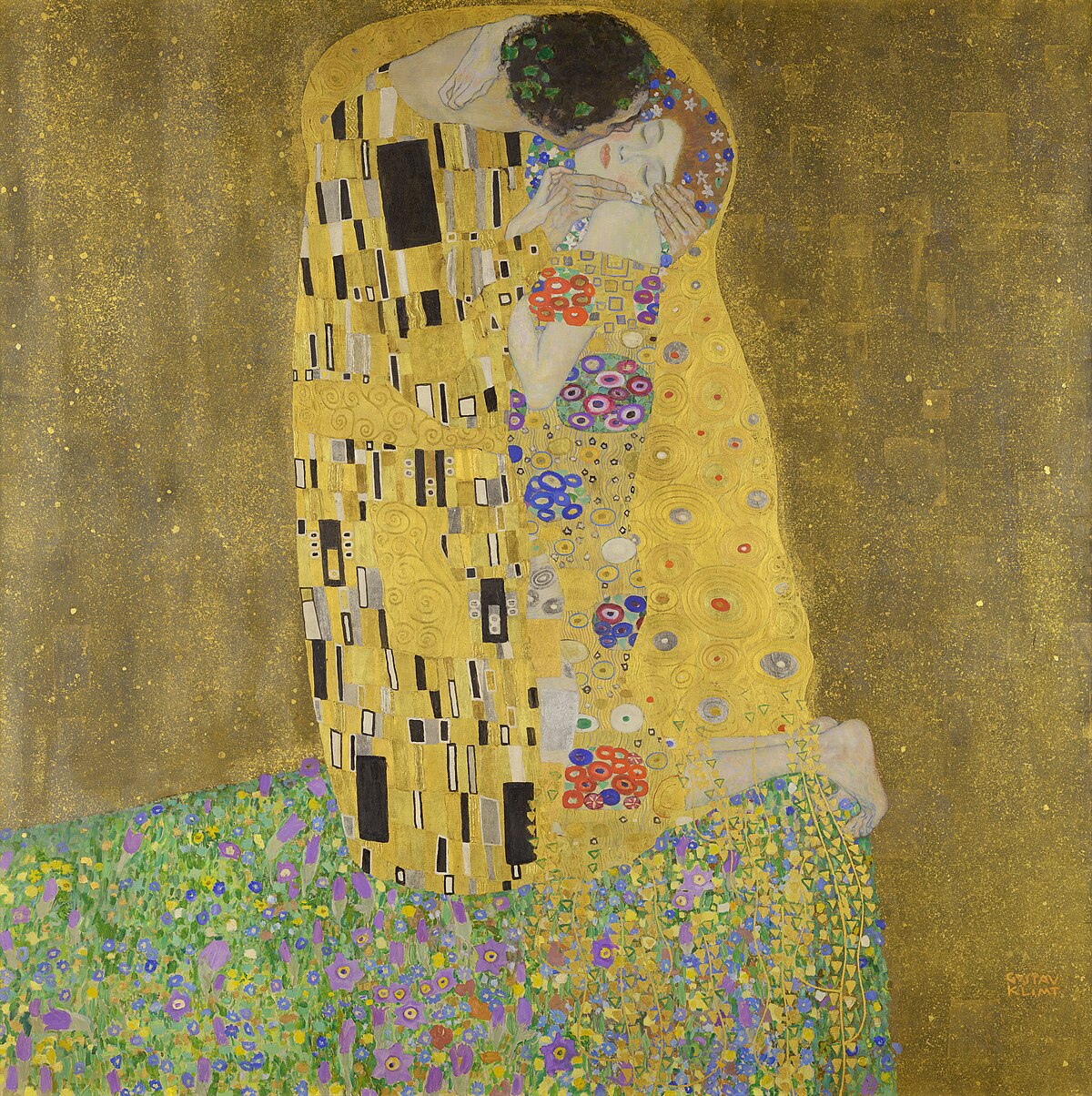
It is the largest Klimt exhibition ever organised in Italy. The number impresses, but it is the ambition that holds the attention: this is not yet another celebration of The Kiss reproduced on thousands of postcards. The Palazzo has chosen to show Klimt in his context, that of the Viennese Secession, the breakaway movement founded in 1897 by a group of artists who rejected Austro-Hungarian academicism with a fierce elegance. Ver Sacrum, sacred spring. Their journal bore a battle name disguised as a promise.
Breaking away with grace
The Viennese Secession shared with every movement of rupture that foundational conviction: official art is dead, and something else must be invented. But where other avant-gardes chose raw provocation, Dada, Futurism, later Fluxus, the Secessionists opted for beauty as a weapon. Klimt, Schiele, Moser, Hoffmann, Olbrich: they did not want to destroy art. They wanted to refound it by making it total. The Gesamtkunstwerk, the total work of art, where painting converses with architecture, furniture, typography, textile. Where everything coheres. Where the boundary between fine art and decorative art dissolves in a sovereign gesture.
It is this totalising ambition that the Palazzo stages. Klimt’s paintings are exhibited alongside Josef Hoffmann’s furniture, Koloman Moser’s posters, jewellery, fabrics, everyday objects transformed into works of art. The visitor does not look at paintings hung on a wall. One enters a world, that of Vienna in 1900, when the imperial capital gazed into the mirror and discovered, beneath the varnish of waltzes and uniforms, something troubled, sensual, dangerously new.
Gold and flesh
One cannot speak of Klimt without speaking of gold. That gold leaf he applied to his canvases with the precision of a Byzantine goldsmith, creating surfaces that oscillate between the religious icon and the erotic image. The bodies of Klimt’s women, Adele Bloch-Bauer, Judith, Danaë, emerge from a gold ground as if from a dream that refuses to dissipate upon waking. The flesh is painted with an almost cruel realism. The setting is pure ornament: geometric patterns, spirals, squares, abstract mosaics that envelop the body like a jewel case.
What fascinates is the contrast. Klimt does not choose between figuration and abstraction. He superimposes them. Adele’s face is painted with the meticulousness of a classical portraitist, the lips slightly parted, the gaze faintly veiled, the hands resting one upon the other in a gesture of nervous restraint. But around her, the world dissolves into pure ornament. The gold is not a background. It is an autonomous space, an abstract territory that exists according to its own laws. Klimt made two regimes of image coexist on the same surface, and that coexistence produced a tension that one hundred and twenty years have not dulled.
There is something in this tension that resonates deeply for anyone who works with contrast. Black and white pose the same question as gold and flesh in Klimt’s work: how does one hold two absolutes together? How does one create a dialogue between two poles that, in theory, exclude each other? The figurative and the abstract. The precious and the raw. Control and abandon. Klimt resolved this equation through superimposition. Others resolve it through the single, irreversible gesture that cleaves the canvas into two territories, black on one side, white on the other, and between them, everything that cannot be spoken.
The courage of ornament
One must grasp what Klimt dared. At the very moment when the European avant-garde was marching toward austerity, Cézanne was reducing form to its volumes, Mondrian was purifying down to the grid, the Bauhaus was proclaiming decoration a crime, Klimt chose ornament. Pattern. Profusion. The decorative fully assumed, claimed, elevated to the status of language. This was not facility. It was an act of aesthetic resistance of considerable audacity.
Adolf Loos, his Viennese contemporary, published Ornament and Crime in 1908, a founding text of architectural modernity that equated decoration with degeneracy. Klimt was doing the exact opposite at the same moment, in the same city, sometimes in the same salons. He covered his canvases with golden spirals, mosaic tesserae, patterns borrowed from Ravenna and Byzantium, and he did so with a conviction that did not waver.
This tension between purity and ornament continues to run through contemporary art. It poses a question to every artist: where do you place the cursor? What degree of austerity feels right to you? What degree of abundance seems honest? There is no correct answer. There are sincere answers and calculated ones, and the eye knows the difference.
Rome as self-evidence
That this exhibition takes place in Rome rather than Vienna, Paris or New York is no accident. Klimt was profoundly shaped by Italy, his travels to Ravenna in 1903 transformed his palette, the Byzantine mosaics of San Vitale infused his work with that gold which became his signature. Rome is the place where ancient art and new art never cease rubbing against each other, where a Caravaggio stands alongside a Morandi in the city’s memory, where the layers of time do not cancel one another but enrich each other.
The Palazzo delle Esposizioni, with its massive neoclassical architecture, is the ideal setting for this confrontation between academic rigour and Secessionist freedom. The building’s columns recall exactly what Klimt and his companions sought to surpass. The works shown within recall that one surpasses nothing by destroying, one surpasses by creating something the old order had not foreseen.
One hundred and eighty works. An entire movement distilled into a single place. And this question floating in the Roman air, between Klimt’s gilding and the April light: must one be maximalist to be radical, or is a single gesture enough, a single stroke, a single contrast laid with sufficient precision for everything to shift?