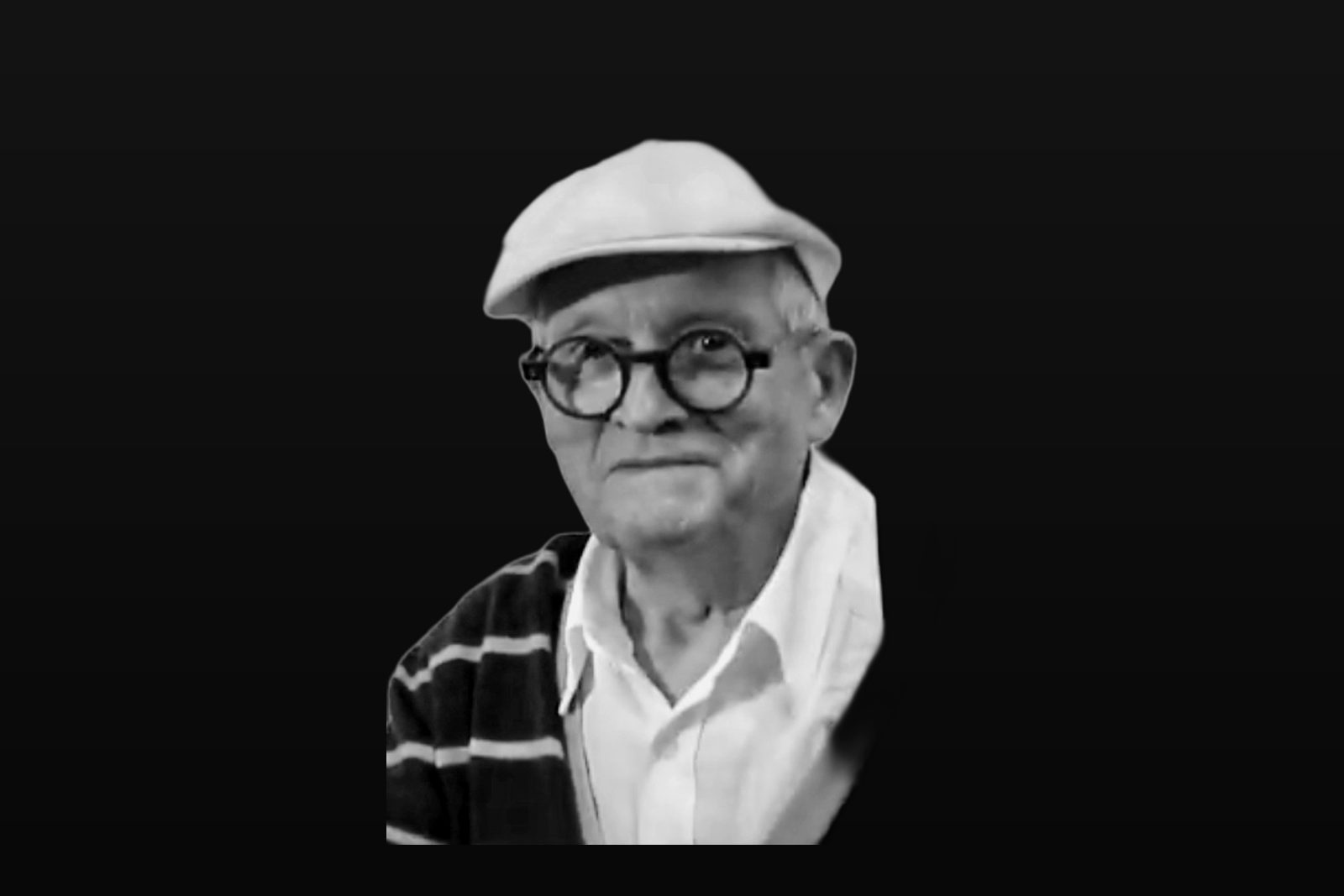
There are works that arrive like silent manifestos. David Hockney at 87 has just transformed the Serpentine Gallery into a theater of the infinite, unfolding a 90-meter frieze that runs along the walls like a meditation on time that passes and time that remains. This free exhibition, accessible until September, reveals how a master of contemporary painting continues to rethink the limits of his medium with the freedom of those who have nothing left to prove.
The frieze winds through the space with disconcerting obviousness. Hockney painted this monumental work in his California studio, in three-meter sections, each panel designed to dialogue with its neighbors without ever mimicking them. The English artist, who has revolutionized our view of color and space since the 1960s, offers here a synthesis of six decades of pictorial research.
Time unfolded over 90 meters
This frieze is not a chronology but a conversation between the ages of painting. Hockney mixes his iconic Californian swimming pools, landscapes from his native Yorkshire, intimate portraits and recent iPad experiments. Each section functions as a temporal window that opens onto different eras of his creation, creating a vertiginous dialogue between the young man discovering Los Angeles in the 1960s and the octogenarian who now paints with the wisdom of experience.
The effect produced goes beyond a simple retrospective. By deploying his work over this unusual length, Hockney creates a new relationship with pictorial duration. The viewer can no longer embrace the whole at a glance, they must walk, stop, return. The frieze imposes its own tempo, forcing a sequential reading that evokes both comic strips and traditional Chinese scrolls.
This approach to pictorial time is reminiscent of the art of the unfinished, this ability to maintain the work in a state of perpetual becoming. For Hockney, incompleteness takes a particular form: each section of the frieze seems to be able to extend infinitely, as if the artist had found a way to paint time itself.
Color as universal language
If Hockney has fascinated for more than half a century, it is primarily through his relationship with color. In this Serpentine frieze, he pushes this mastery to its climax. The blues of his Californian swimming pools dialogue with the acid greens of his English landscapes, creating chromatic harmonies of rare sophistication. The artist uses color as a universal language, capable of transcending temporal and geographical barriers.
This approach to color finds a particular echo in my own practice with India ink. Where Hockney explores all the nuances of the chromatic spectrum, I focus on the dialogue between black and white, this fundamental tension that structures pictorial space. Our approaches converge in this desire to make color, or its absence, a vector of pure emotion.
The British octogenarian also demonstrates that technical innovation has no age. His recent iPad experiments, integrated into this frieze, prove that a master can still rethink his medium. This constant capacity for adaptation makes Hockney a unique figure in the contemporary artistic landscape.
Space reimagined, art liberated
The Serpentine Gallery, with its curved spaces and zenithal light, offers a perfect setting for this monumental frieze. Hockney conceived his work specifically for this place, playing with Zaha Hadid’s architecture to create an initiatory journey. The free exhibition allows all audiences to access this unique experience, democratizing access to a work of rare ambition.
This democratization of art resonates with contemporary issues of cultural accessibility. Hockney, who has always refused the elitism of the art world, offers here a monumental work accessible to all. The free nature of the exhibition is not anecdotal: it fits into the artist’s humanist vision, convinced that art must speak to everyone.
The installation also transforms our perception of museum space. By occupying the walls over this exceptional length, the frieze redefines the relationship between the work and its environment. It does not exhibit itself in space, it becomes the space, creating total immersion that evokes the environments of James Turrell or the installations of Olafur Eliasson.
The lesson of a master
At 87, David Hockney offers us more than an exhibition: he delivers a masterful lesson on artistic longevity. This Serpentine frieze proves that an artist can continue to innovate to the end, provided they keep their child’s gaze on the world intact. The British octogenarian still paints with the curiosity of one who discovers, mixing the experience of a lifetime with the freshness of the moment.
This ability to constantly reinvent himself echoes my own research on the irreversible gesture. Where I work in the instantaneous nature of ink that does not forgive, Hockney explores the long temporality of creation, this patience that allows one to refine a vision over decades. Our approaches differ but converge toward this same requirement: making each stroke a total commitment.
The Serpentine frieze ends with a particularly luminous section, as if Hockney wanted to finish on a note of hope. This final light is not accidental: it evokes this unique capacity of the artist to transform the everyday into epiphany, to reveal the hidden beauty of the ordinary world. This is perhaps his greatest teaching: showing that art does not consist in creating beauty, but in revealing it where it hides.