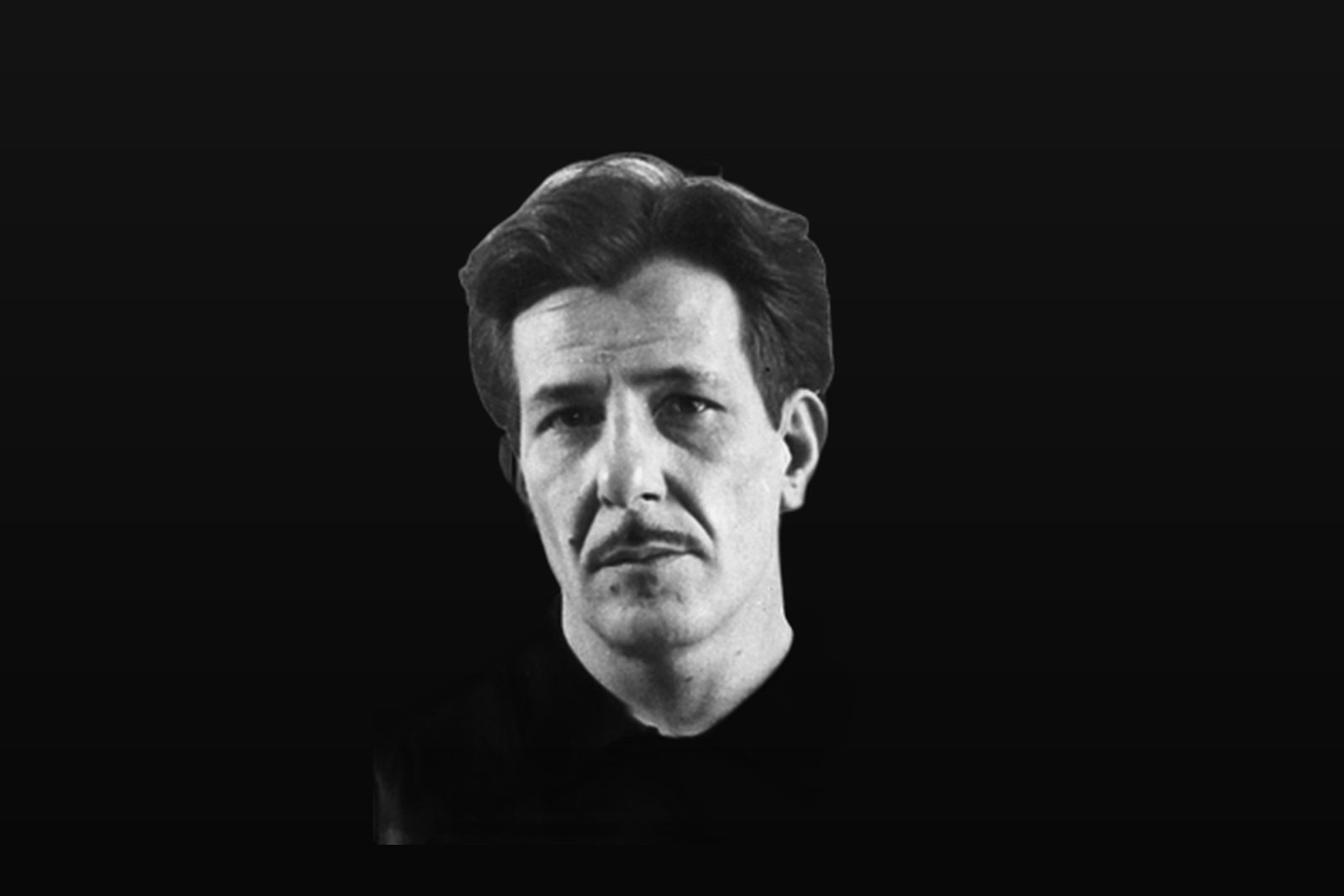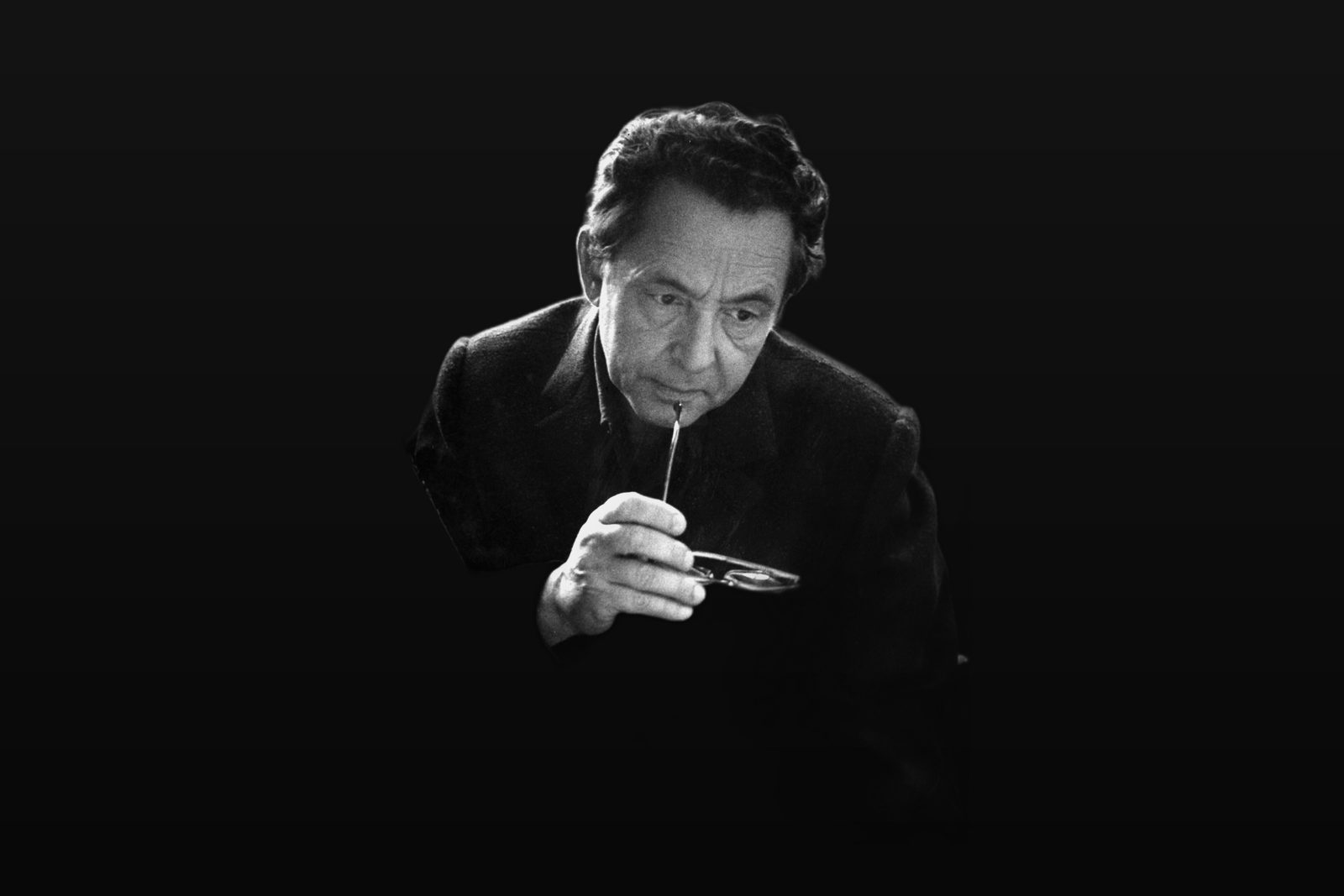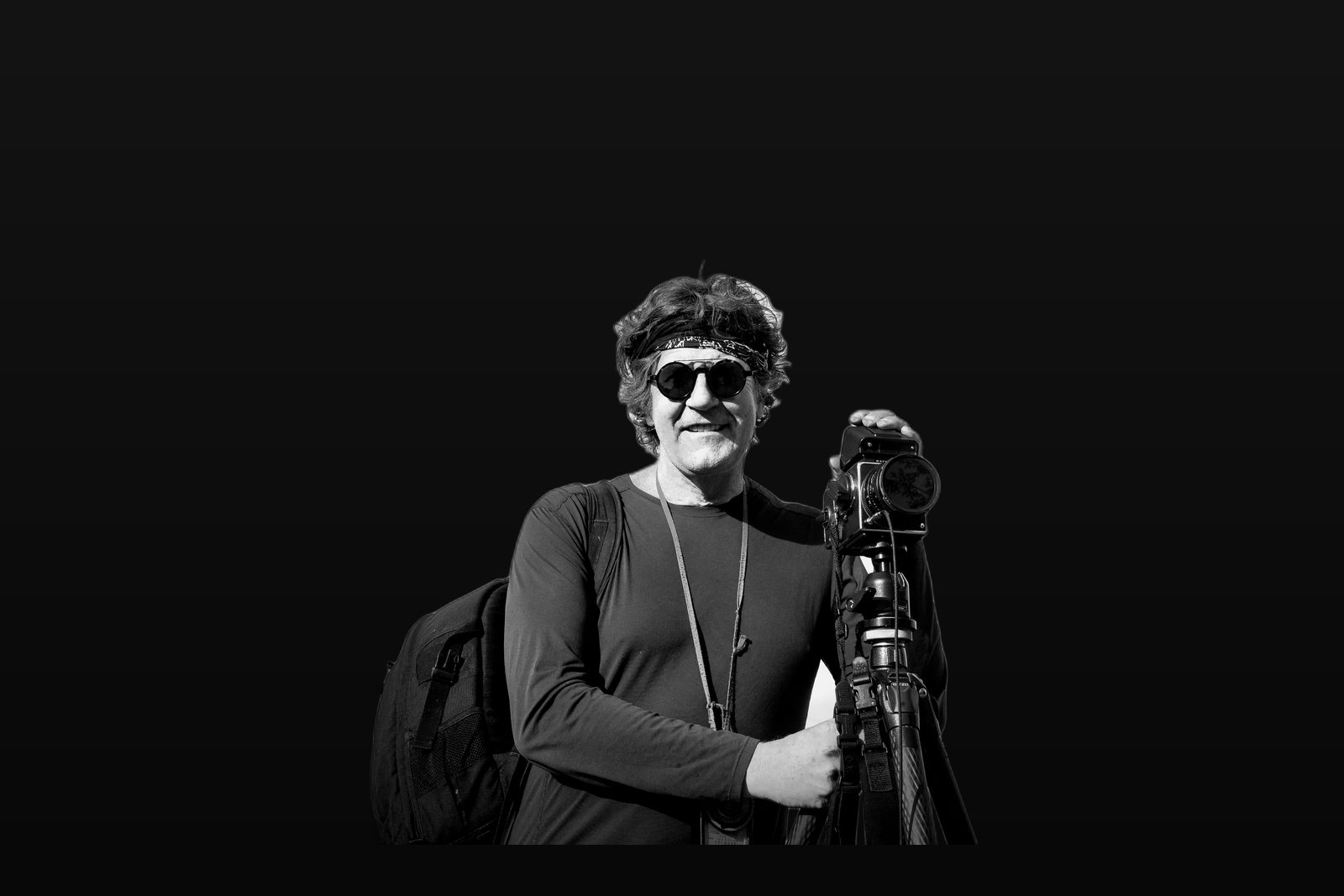
If Hiroshi Sugimoto brings to Coralie J Schmitt’s photography the logic of the minimal apparatus, Michael Kenna (born 1953) brings something else, harder to formulate and just as decisive: the conviction that light itself can be the raw matter of the image. Not the illuminated subject. Not the captured scene. Light as a substance, settling on the film as ink on paper.
The discipline of long exposures
Kenna is British, trained at the London College of Printing in the late 1970s, settled in the United States since 1979. His work unfolds across fifty years around a stable protocol: black and white landscapes, square format, long exposures. Exposure times range from a few seconds to several hours. This discipline produces images that resemble no other landscape photography.
In the series Mont-Saint-Michel (1994-2002), Hokkaido (2002-2010), Le Désert blanc (2005-2009), Les jardins du Japon (1987-2018), a principle returns: the long exposure dissolves the agitation of the visible. Water, which is never still, becomes smooth as a silver mirror. Leaves, which quiver in the wind, become a soft blur that erases the vegetation in favour of its mass. The sky, which changes every minute, becomes a single uniform expanse. What remains is the essential: the structure, the frame, the proportion.
Roma per sempre, a long reading
This logic directly illuminates Schmitt’s Roma per sempre series. The eight photographs taken in the Italian city do not seek to capture Rome as event. They do not photograph the Vatican crowds, the Trastevere terraces, the Corso traffic. They photograph what remains when all this has been subtracted: a wall, an opening, a cast shadow, an architectural proportion.
Kenna’s ethics is here in direct lineage. Not so much in the material used (Kenna works in silver gelatin, Schmitt with a more contemporary technology) as in the gaze: each time, it is a matter of erasing what passes to let appear what endures. This operation demands a rare discipline: one must know how to wait, choose, subtract.
The shared Japanese lesson
Kenna and Schmitt share, moreover, an implicit reference to the Japanese aesthetics of silence. Kenna made this explicit through his Japanese series (Hokkaido, Les jardins du Japon) and his personal engagement with photography in Japan. Schmitt has not, to date, produced an explicitly Japanese series, but the attention to emptiness, to interval, to the little, traverses the whole of her work. This kinship is not an influence, it is a community of ethics.
In the Japanese tradition, the right image is the one that suggests more than it shows. The concept of yūgen, often translated as “mysterious depth”, designates precisely this capacity of a work to indicate without naming, to leave open without leaving empty. Kenna carried this ethics into contemporary landscape photography. Schmitt extends it in an urban and intimate vocabulary.
The acknowledged divergences
At least two differences distinguish the two practices.
The scale of displacement. Kenna travels massively. His practice is inseparable from the prolonged frequenting of distant places (Hokkaido, Mont-Saint-Michel, the white desert of Egypt, the Kyoto gardens). Schmitt works nearby, in Italy and in her studio. This difference of scale changes the very nature of the corpus: where Kenna builds an anthology of places of silence, Schmitt builds an intimate register.
The long exposure technique. Kenna assumes a specific technicity (ND filters, exposures of several hours, silver gelatin development). Schmitt has not adopted this protocol. Her photography obeys rules of framing and waiting, more than of exposure duration. This difference matters: it places Schmitt’s images in another photographic time, that of the chosen instant, rather than the prolonged instant.
The legacy that remains
What remains, beyond these divergences, is the conviction that a photograph can be reduced to an apparatus of subtraction. Not enrichment, not accumulation, not capture. Subtraction. This idea is not spontaneous in contemporary photography, where high definition pushes one to show ever more. Kenna has spent fifty years demonstrating the opposite. Schmitt extends this ethics in her own corpus, at her own scale, without imitation but with a kinship of method that makes the images dialogue.
Sources and further reading
- Michael Kenna, Le Mont-Saint-Michel, Marval, 2007
- Michael Kenna, Hokkaido, Nazraeli Press, 2006
- Anne Biroleau, Michael Kenna : Retrospective, Skira/Bibliothèque nationale de France, 2009
- Michael Kenna : Forms of Japan, Prestel, 2015