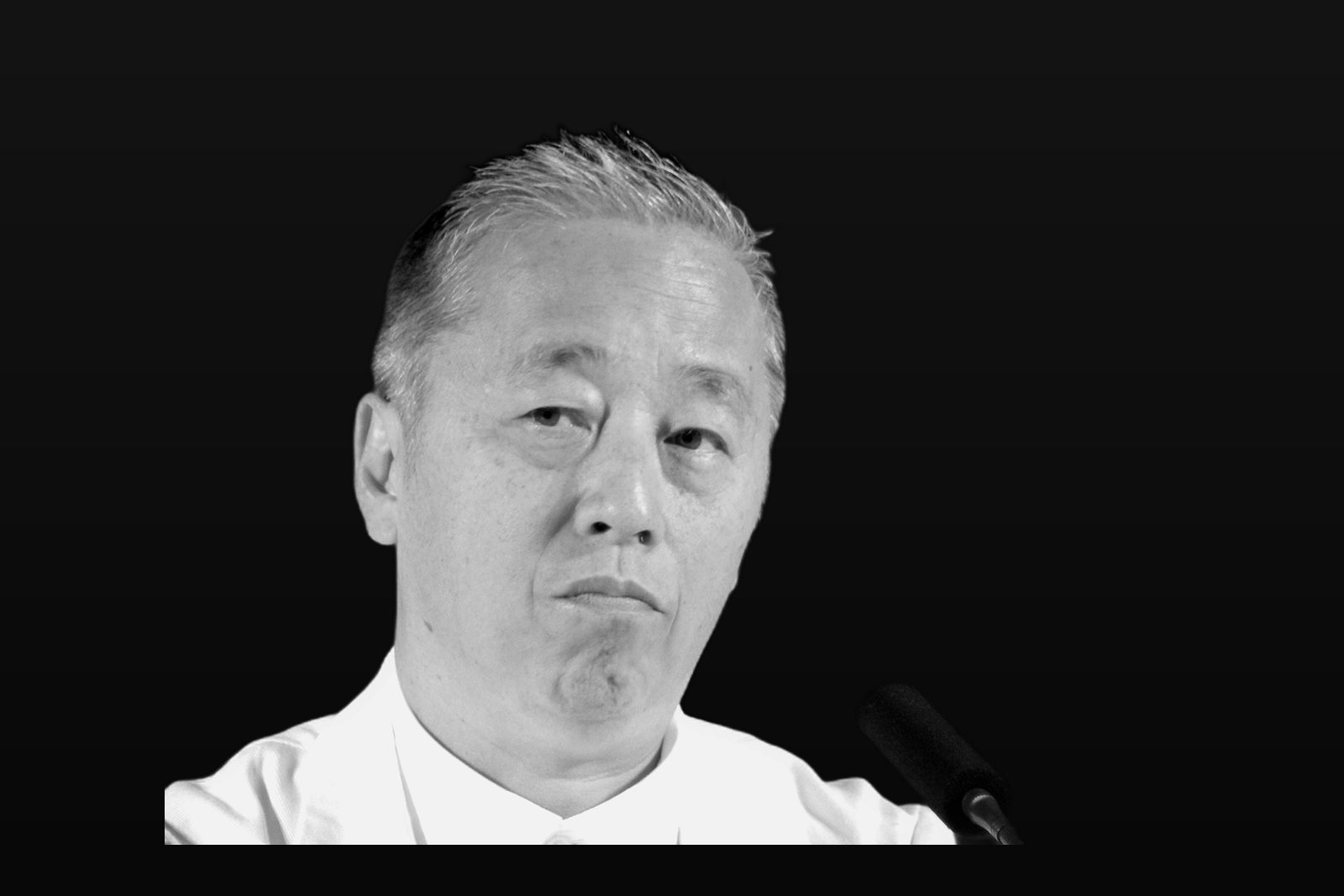
Coralie J Schmitt’s photography is not learned at school. It is built by looking at length at a few tutelary works and by interrogating what they made possible. Hiroshi Sugimoto (born 1948) is one of those works. Without him, the very idea that a photograph could be reduced to a minimal apparatus would probably not have become, in Schmitt’s work, such a clear discipline.
The conceptual photographer
Sugimoto is not a reporter. He is not a portraitist. He is not a fashion photographer. Since his New York beginnings in the mid-1970s, he has been an artist who uses photography as an apparatus for thinking. This position is rare, and it makes the work so specific that it cannot be confused with any other.
Each of his series functions as a protocol: a rule posed, methodically declined across dozens of images, until the possibility is exhausted. Theatres (begun in 1976) photographs empty cinema halls, with an exposure time equal to the duration of the film projected. The result: a white rectangular screen at the centre of an empty architecture, bathed in the cumulative light of every shot of the film. Seascapes (begun in 1980) photographs expanses of water and sky, frontally, the horizon line strictly in the middle. Architecture (begun in 1997) photographs the masterpieces of modern architecture with a deliberately defocused lens, producing blurred, out-of-focus images.
The apparatus as discipline
What these series share is a logic of the apparatus. A good photograph, in Sugimoto’s vocabulary, is one that makes visible the protocol that produces it. Not the encounter with an exceptional subject. Not the chance of a decisive moment. The apparatus. This inversion is radical: it displaces the authority of the photograph from the eye of the photographer to the organising principle he managed to set.
This logic structures Schmitt’s photographic practice. The images of the Voile, Silence, L’abandon, Passage corpus do not depend on an exceptional encounter with a subject. Each time, they pose the same question: what must remain when everything has been removed? This interrogation is the local formulation of the Sugimoto apparatus, transposed into an intimate vocabulary (the studio, the interior, the Italian city) rather than a monumental one (cinema halls, oceans, architectural masterpieces).
The absence of spectacle
A second lesson from Sugimoto silently traverses Schmitt’s work: the refusal of spectacle. No Sugimoto image seeks to astonish by its subject. A grey sea. A white screen. A blurred building. These subjects are deliberately poor in narrative information. Their plastic richness comes from elsewhere: from the exposure time, from the rigorously frontal framing, from the silver gelatin texture that renders light as matter.
Schmitt extends this ethics. Voile tells no story. It is a veil and a light. L’abandon tells no story. It is a sheet and a framing. This refusal of spectacle is not a deliberate poverty. It is a trust in the ordinary visible, and in the capacity of a minimal apparatus to make it interesting.
The acknowledged divergences
Several differences distinguish Schmitt’s practice from Sugimoto’s.
The scale of the series. Sugimoto works in long cycles, stretched over decades, with dozens or even hundreds of images per series. Schmitt, to date, offers more contained series (eight pieces for Roma per sempre, for example). This difference in scale corresponds to a difference in institutional positioning: Sugimoto produces for the museum, Schmitt builds for the wall of a collector.
The relation to silver gelatin technique. Sugimoto works with a large-format view camera, in large-dimension silver gelatin prints, in a very demanding technical economy. Schmitt assumes a more contemporary apparatus and a less burdensome technique, bringing production closer to the conditions of a private studio.
The intimate subject. Where Sugimoto chooses emblematic, even mythological, subjects (the ocean, modern architecture, cinema), Schmitt works at the scale of studio and interior. The corpus attends to ordinary objects: a veil, a sheet, a corner of a room, a street arch. This difference in iconographic scale does not correspond to a lesser ambition. It corresponds to another strategy: to make the minimal apparatus a discipline applicable to the everyday, not only to monuments.
The lesson that remains
What remains, beyond these divergences, is the conviction that a photograph does not need an exceptional subject to exist. This conviction is rare. Contemporary photography, since Instagram, is massively structured by the opposite idea: that the subject must attract the eye by its novelty, its strangeness, its anecdote. Sugimoto has spent fifty years demonstrating the opposite. Schmitt extends the lesson, in her vocabulary and scale, but with the same discipline.
This is why Schmitt’s photography is neither a complement to her painting nor a studio diary. It is a third language, endowed with its own ethics, and it has found in Sugimoto one of its most solid anchorages.
Sources and further reading
- Hiroshi Sugimoto, Sugimoto : Seascapes, Damiani, 2015
- Hiroshi Sugimoto, Theatres, Damiani, 2016
- Hiroshi Sugimoto, Hatje Cantz, Hirshhorn Museum, 2006, exhibition catalogue
- Surface of Revolution, Hiroshi Sugimoto, Pace Gallery, 2017