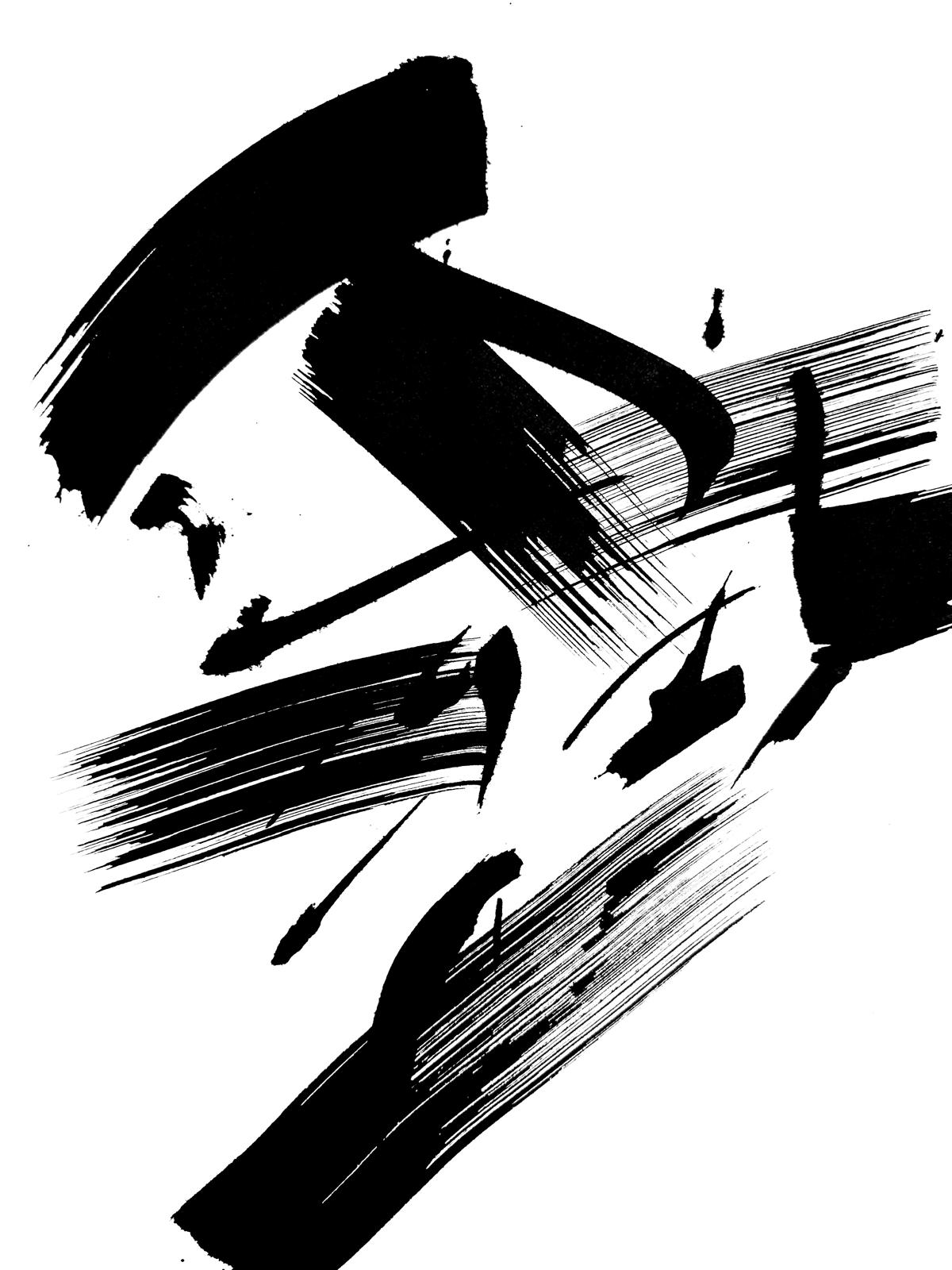
Indian ink is not one medium among others in Coralie J Schmitt’s work. It is the matrix. The founding discipline, the one that decides everything upstream, the one to which acrylic and photography return as to a point of origin. Fifteen pieces compose the corpus to date, numbered in Roman numerals, untitled, like a score that one refuses to comment on. This restraint is not anecdotal. It already says almost everything.
A writing without reworking
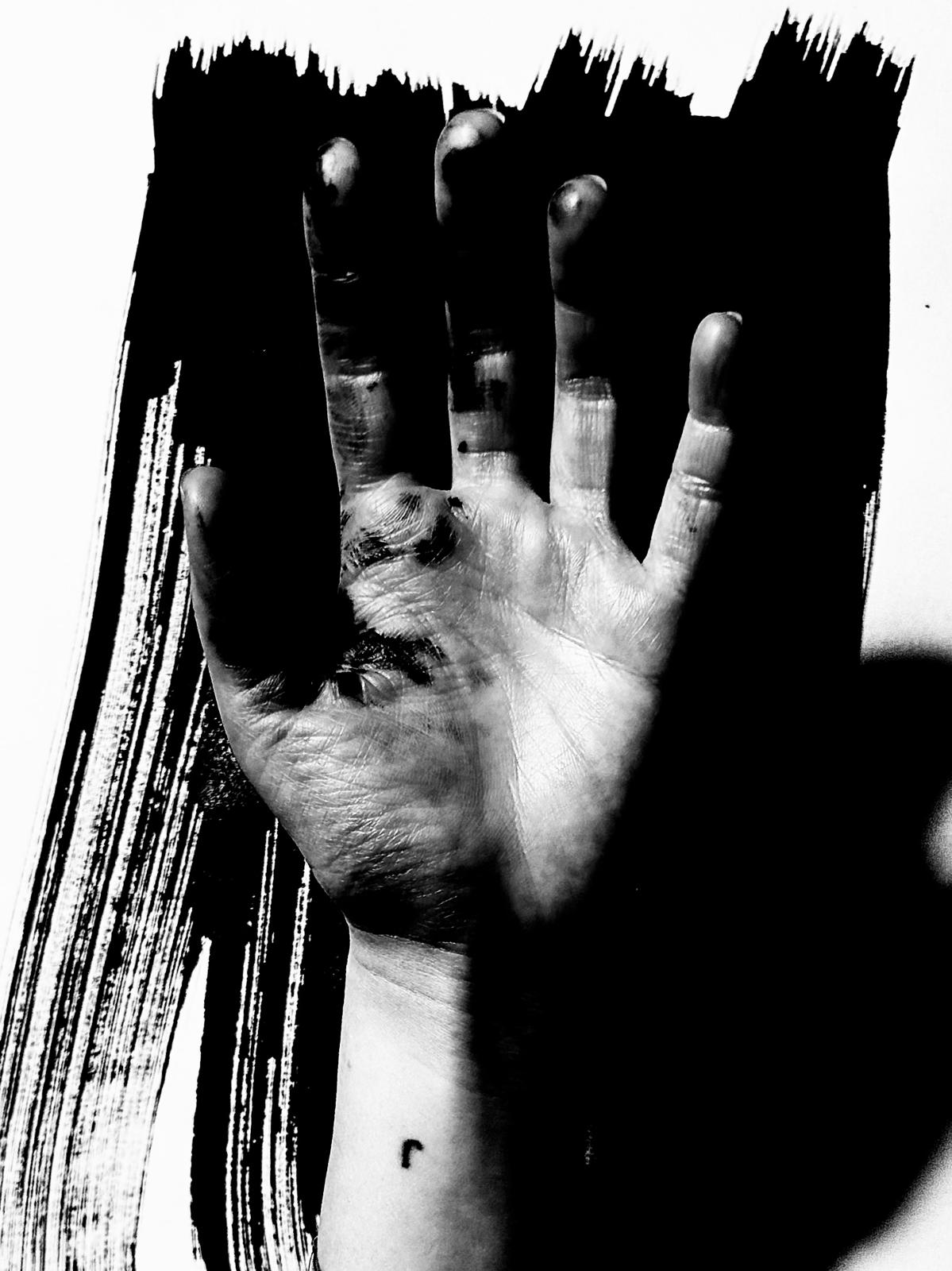
Indian ink imposes a simple and terrible rule: the gesture is irreversible. The brush touches the paper, and the trace exists. No retake possible, no correcting layer, no pentimento. This constraint is in reality a liberation: it forces the decision and banishes hesitation. Each piece of the corpus reads as the trace of a moment when one had to choose, quickly, rightly.
This logic of the irreversible inscribes the work in a precise lineage. Japanese calligraphy, that of the zen monks of the Tokugawa or modern masters such as Yu-ichi Inoue, shares this ethics of the single gesture. The West has drawn from it its own tradition: Pierre Soulages and outrenoir, Henri Michaux and his Mouvements of 1950 in ink, Franz Kline and his monumental black-on-white calligraphies, Hans Hartung and his T series, each a flash. Schmitt cites none of them. She mimics none. But she inherits the same conviction: what happens between the hand and the sheet engages the whole being.
Emptiness as matter
The other strong marker of the corpus is the attention paid to emptiness. In Encre de Chine III, a vertical stroke descends, heavy, then stops. All the rest of the sheet remains intact. This white is not a background, it is a matter. It bears, it sustains, it makes the reading of the stroke possible. Remove it, and the mark no longer exists.
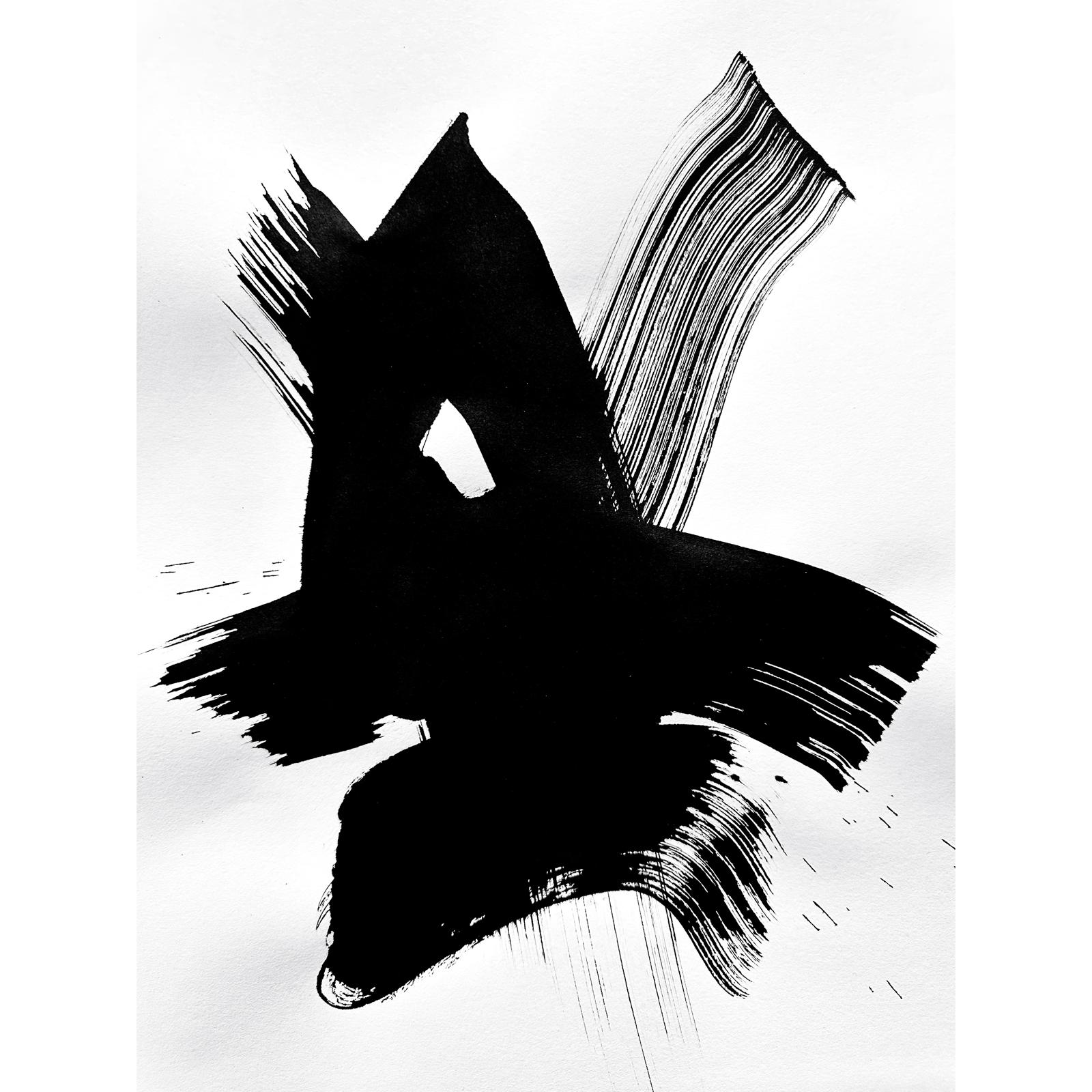
The aesthetics of ma, the Japanese concept designating the structuring interval, silently traverses the series. This is what distinguishes these sheets from a simple American-style expressionist gesturality. Where the action painting of Jackson Pollock saturates the canvas, where Cy Twombly covers it with dense scratches, Schmitt subtracts. She lets it breathe. She trusts the paper.
Fifteen declensions of a single constraint
Taken together, the fifteen numbers form a variation around identifiable parameters: the length of the stroke, its speed, the load of ink, the angle of attack, the amount of emptiness left around it. Encre de Chine I explores a compact mass that dilutes into splashes. Encre de Chine VII holds on two calligraphic curves almost Chinese in their economy. Encre de Chine XII assumes a central saturation that recalls the Empreintes of Yves Klein in their principle (the body that marks), while remaining strictly gestural.
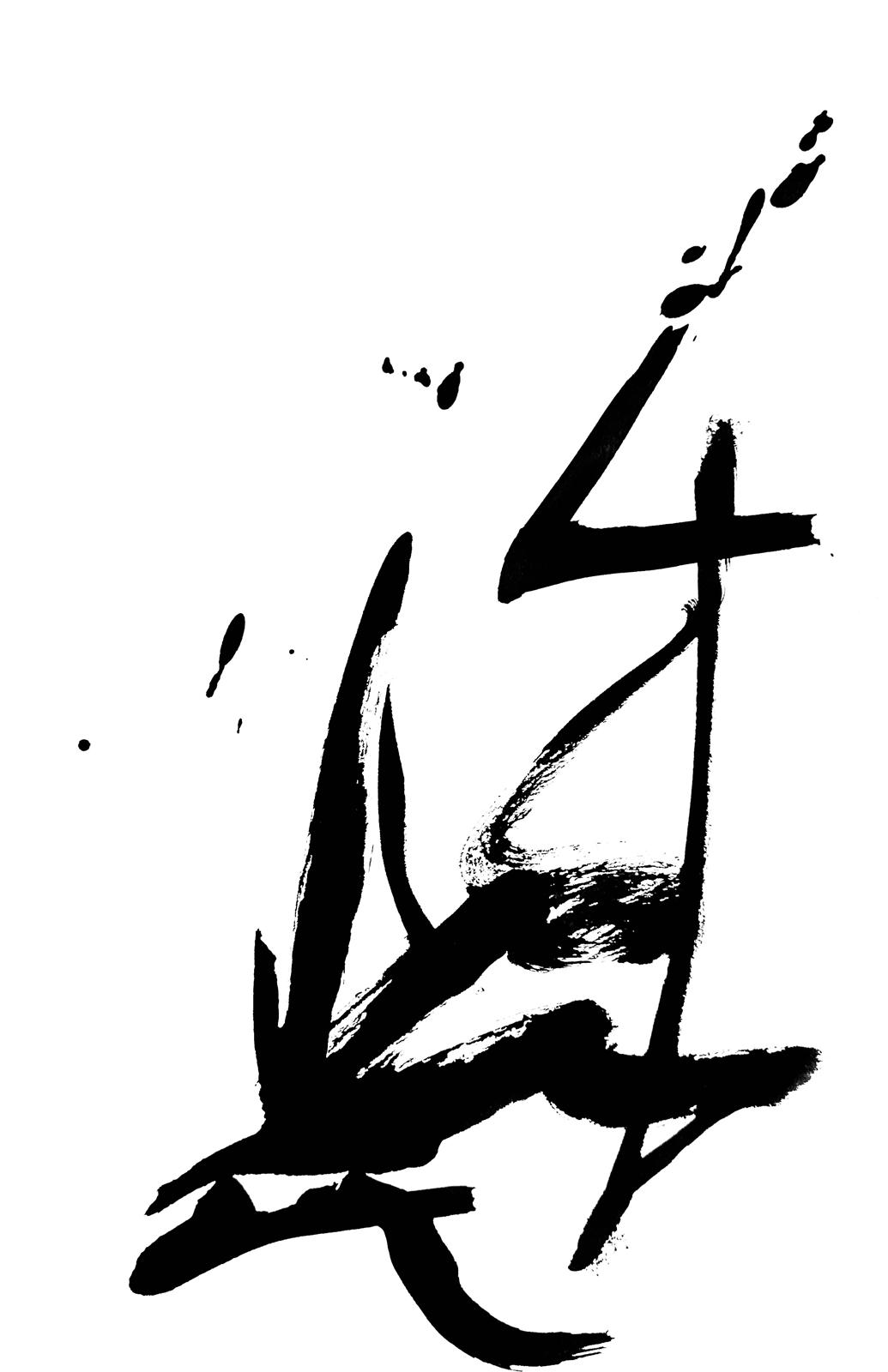
This series logic, in which each piece answers the others without ever repeating them, structures the coherence of the corpus. One recognises a Schmitt Encre de Chine by its restraint. By what is not in it. By the fact that the author has chosen to efface herself behind the plastic decision.
Why begin with ink
If ink is founding in Schmitt’s practice, it is because it carries everything else with it. The discipline of the irreversible stroke is found again in acrylic painting, but displaced towards mass and layer. The rigour of the pared-down statement is found again in photography, but displaced towards light and framing. Without the ink, the global work would lose its centre of gravity.
This precedence also explains why the corpus remains numbered. To give titles to these fifteen pieces would be to impose on them an external narration. To leave them bare is to recall that they speak of a single thing: the possibility, for a black mark on a white sheet, to stand upright with nothing but itself.
This is exactly what Soulages sought in outrenoir. What Michaux pursued in his mescaline signs. What zen calligraphy has practised for eight centuries. Schmitt inscribes herself in this continuity without noise, without manifesto, by the sole pieces she produces.
Recommended reading
- Pierre Soulages, Écrits et propos, Hermann, 2009
- Henri Michaux, Mouvements, Gallimard, 1951
- Yves Bonnefoy, L’arrière-pays, Flammarion, 1972
- François Cheng, Vide et plein : le langage pictural chinois, Seuil, 1979