Photography occupies in Coralie J Schmitt’s work a singular position. Neither complement, nor relaxation, nor illustration of the other mediums: it constitutes a third autonomous language, endowed with its own grammar and its own historical anchorages. Where ink engages the irreversible gesture and acrylic the material construction, photography engages the reading of the real. Or more precisely, its reduction.
An economy of means
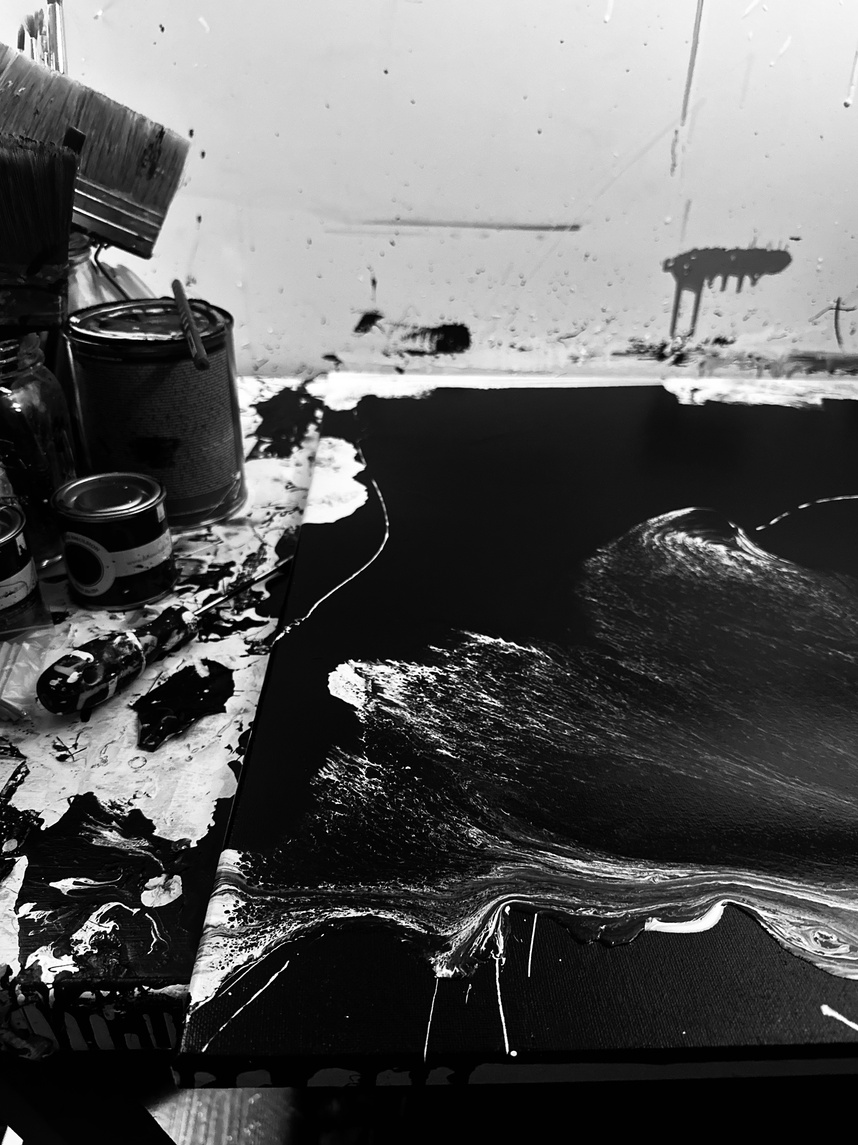
The photographic corpus unfolds in black and white, without exception. No colour, no demonstrative retouching, no staging. The images come down to a minimal apparatus: a light, a framing, a distance. Voile, Silence, L’abandon, Passage all function according to the same principle of economy. What is at stake there does not belong to the anecdote but to the pure composition.
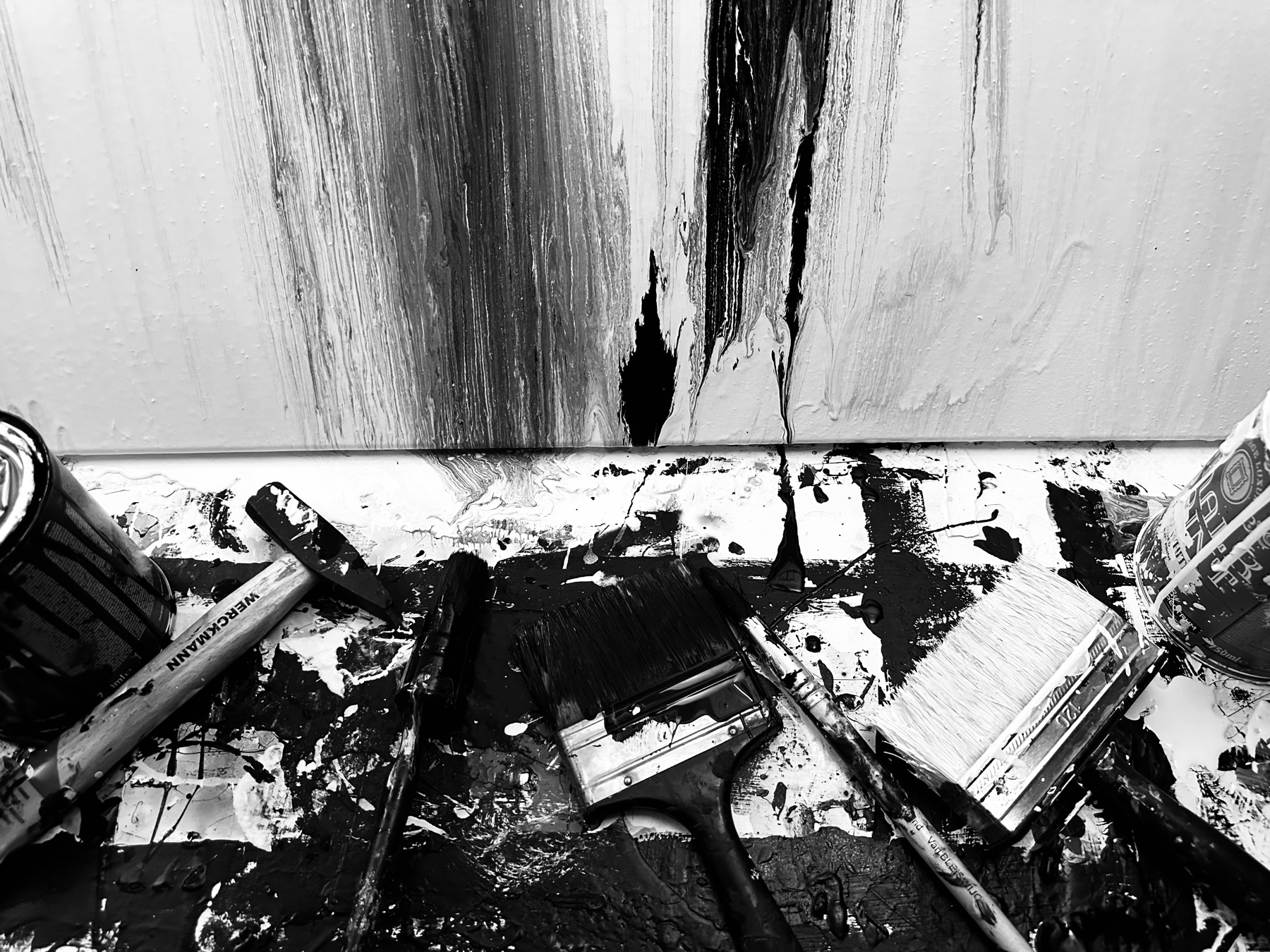
The studio, the architecture, the domestic interiors compose the principal territories. But these subjects are never treated as such: they serve as pretexts for a reading of the visible. A corner of the studio becomes a study of shadows. An arch becomes a geometric module. A crumpled sheet becomes a score of greys. Schmitt’s photography does not describe, it samples.
Roma per sempre
The Italian series deserves a separate development. Eight pieces produced in the city, under the common title Roma per sempre. The choice of title commits: it speaks of attachment, not erudition. Rome is not treated there as a tourist or an art historian. It is captured as a lesson in proportions.

Architecture, planes, thresholds. No image seeks the frontal monument or the recognisable cliché. It is a Rome perceived at eye level, in the details that the habitual eye neglects: the angle of a wall, an opening, a cast shadow. What the corpus retains is not the city as spectacle, it is the city as geometric apparatus.
Three anchorages, one ethics
To grasp precisely what this photography seeks, the lineages must be named.
Hiroshi Sugimoto first. The Japanese photographer born in 1948, author of the series Theatres (1976), Seascapes (1980) and Architecture (1997), pushed photographic minimalism to a point that few have equalled. Sugimoto reduces each image to an apparatus: a plane, a light, a duration. This logic of the minimal apparatus structures Schmitt’s work. Voile holds on a veil and a light source. Silence holds on a corner of the studio and a measured darkness. Everything else is subtracted.
Michael Kenna next. The British photographer, famous for his long-exposure black and white landscapes, treats light as the true matter of the image. His Hokkaido (2002-2010) or his Mont-Saint-Michel (1994-2002) show what it is possible to remove for something to remain. Roma per sempre shares this economy: the city stripped down until it becomes a diagram of light.
Saul Leiter finally, in his monochrome practice. Leiter, who died in 2013, is best known for his colour photographs of 1950s New York. But his black and white corpus, belatedly rediscovered, shows an attention to the urban fragment that Schmitt extends. An arch, a sheet, a textile detail: these are not subjects, they are pretexts for composition.
Silence as programme
If ink engages the gesture and acrylic engages the matter, Schmitt’s photography engages silence. Not the absence of sound, but the active withdrawal. Each image refuses chatter. None has a narrative title (Voile, Silence, L’abandon are concepts, not stories). None seeks to move by the anecdote. None solicits identification.
This strategy inscribes the practice in a precise lineage: that of the Japanese school of silence, heir to wabi-sabi and zen aesthetics, where the real is never saturated but always suggested. This aesthetics, which irrigates Sugimoto and which is found in Masao Yamamoto, Kenro Izu or more recently Rinko Kawauchi, considers that the image must leave the viewer the space of his or her own reading.
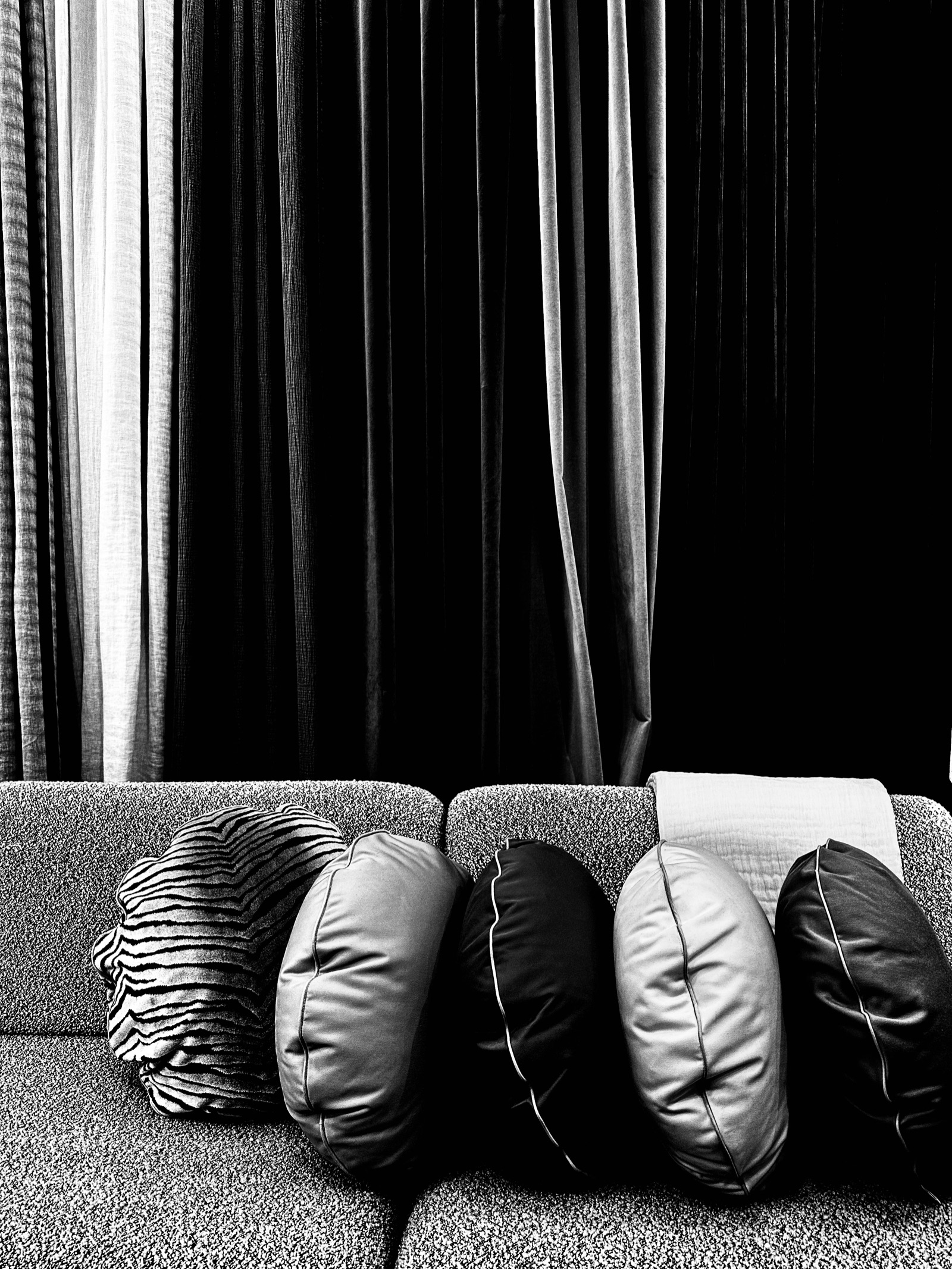
This is exactly what Schmitt does. Voile tells no story. Roma per sempre describes nothing. L’abandon denounces nothing. These images pose a state of the visible, and withdraw. The viewer does the rest.
The unity of the gesture
At the end of a journey through the three mediums (ink, acrylic, photography), a question imposes itself: what holds all this together? The answer is not thematic, nor aesthetic. It is ethical.
In her manifesto, Schmitt claims a measured audacity, an essential value, a right form. These three requirements traverse the three mediums and explain why the passage from one to the other is not experienced as a bifurcation. Ink, acrylic and photography are three translations of the same attention. Three ways of asking the same question: what must remain on the sheet, the canvas, the film, for the trace to be necessary?
It is this question, and not a style or a subject, that defines the work. It is enough to make it identifiable among hundreds of contemporary practices, and to explain why it inscribes itself, without fanfare, in a genealogy as serious as that of Soulages, Kline, Sugimoto and Kenna.
Recommended reading
- Hiroshi Sugimoto, Architecture, Hatje Cantz, 2003
- Michael Kenna, Forms of Japan, Prestel, 2015
- Saul Leiter, Early Black and White, Steidl, 2014
- François Cheng, Cinq méditations sur la beauté, Albin Michel, 2006