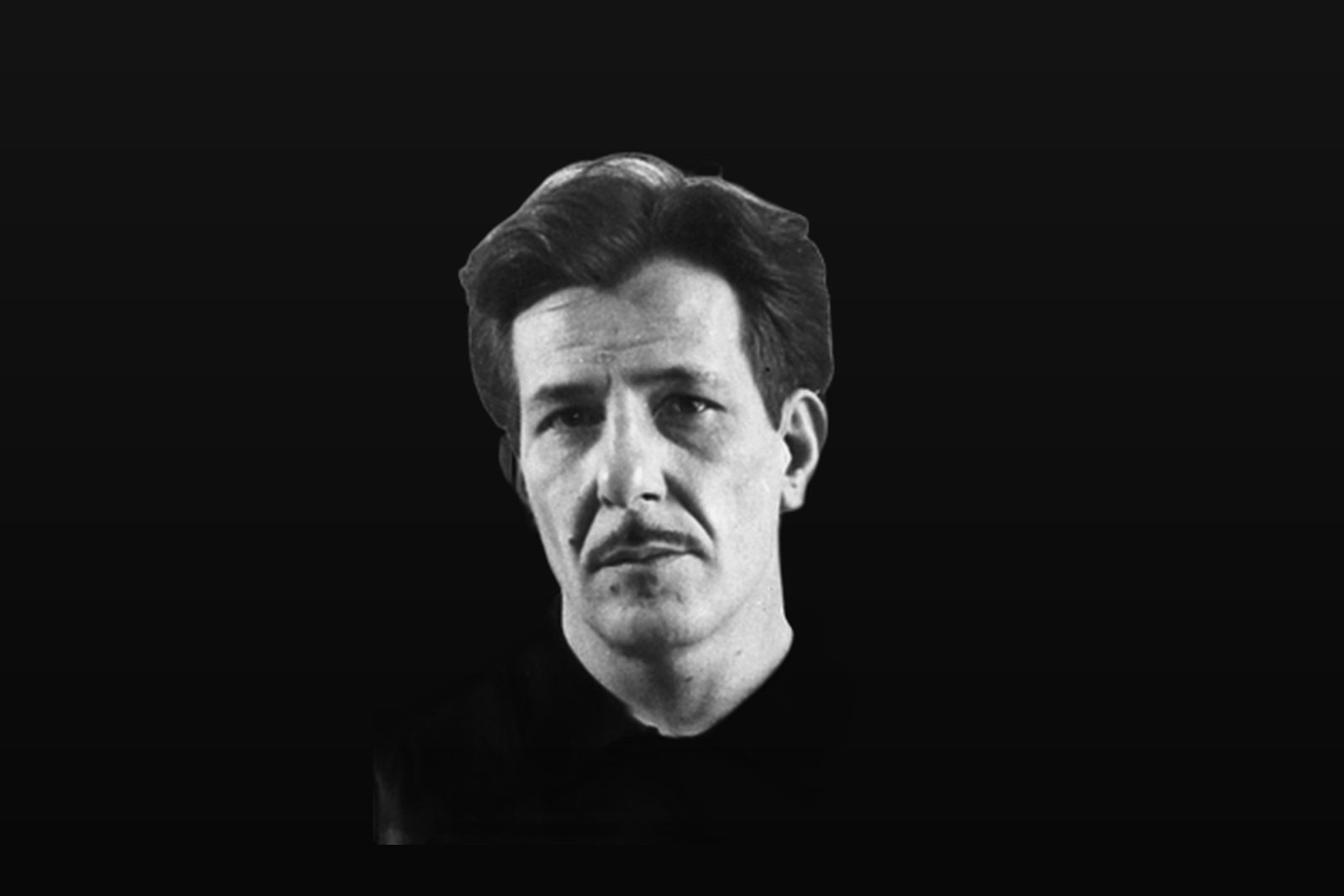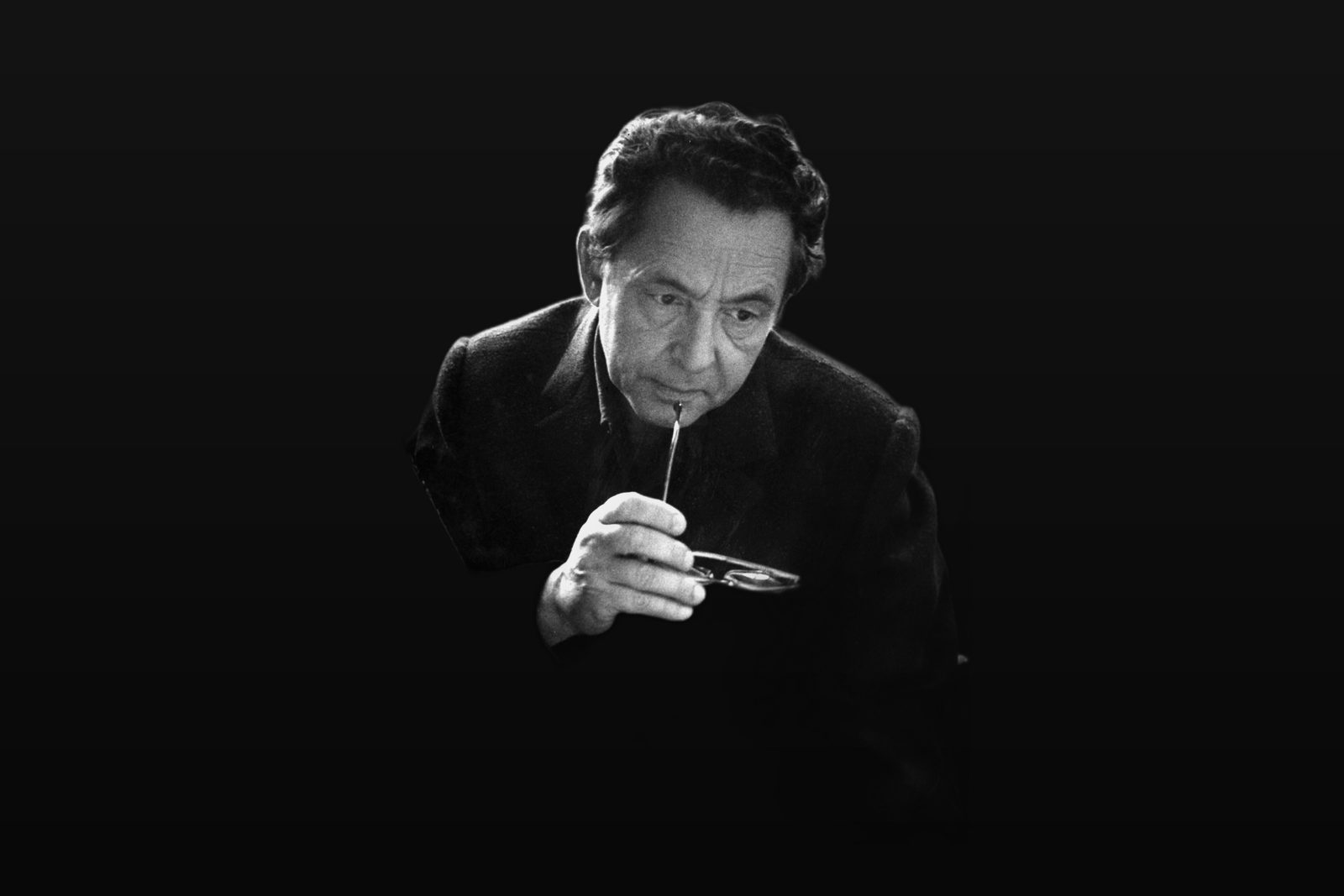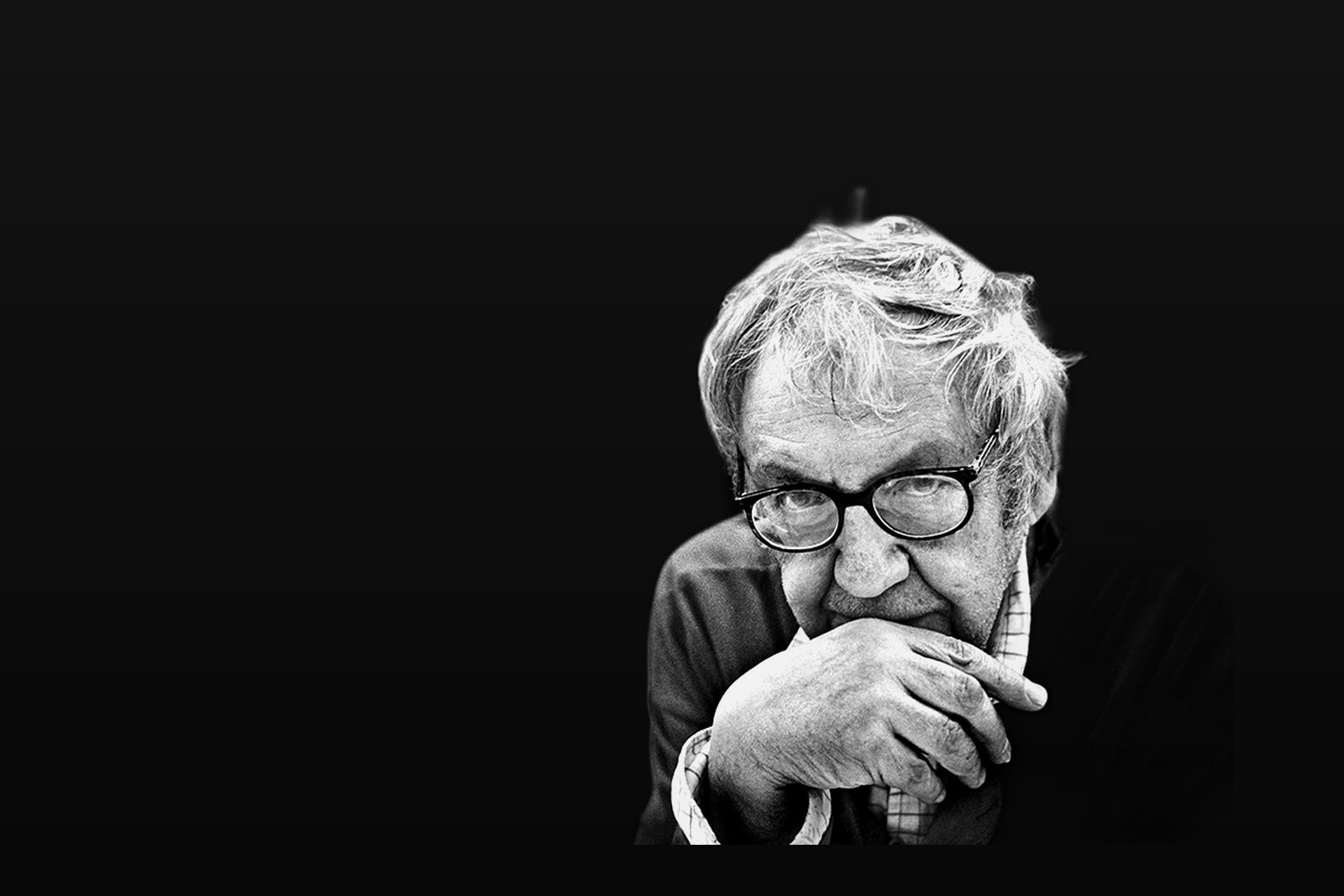
Seventh and final volume of the Lineages series. Saul Leiter (1923-2013) is probably the one of the seven whose kinship with Coralie J Schmitt is the most discreet. Not the founding matrix that Pierre Soulages is, not the architectural grammar of Franz Kline, not the calligraphic discipline of Henri Michaux or Hiroshi Sugimoto. Something more localised: the conviction that an urban fragment can suffice to compose an image.
The painter who photographed
Leiter is, like Michaux, a particular case. Born in 1923 in Pittsburgh, son of a rabbi, he abandoned his religious studies to become a painter in New York in 1946. Photography was, for a long time, only an ancillary practice. He made it commercially for fashion magazines (Harper’s Bazaar, Vogue, Esquire) from the 1950s onwards, but his true career only began at the turn of the 1990s, when the art world rediscovered his colour photographs from the 1950s and belatedly raised him to the rank of major author.
This story matters. Leiter spent fifty years photographing without seeking institutional recognition. This independence produced a work strangely free of the canons of the street photography of its time. Where Robert Frank documented America (The Americans, 1958), where Garry Winogrand captured frontal urbanity, Leiter framed fragments. A fogged window. The edge of a coat. A reflection in a puddle.
The monochrome corpus
If Leiter is today known for his colours (the reds, the yellows, the deep blues of New York seen through a window), his monochrome corpus, largely unknown in his lifetime, has since his death in 2013 been the object of a progressive rediscovery. These black and white photographs are what most directly illuminate Schmitt’s practice.
In this corpus, Leiter frames New York interiors, arches, staircases, silhouettes of passers-by seen from behind or partly hidden. What strikes each time is the refusal of the establishing shot. Leiter does not photograph New York. He photographs a detail of New York, treated as a plastic event in itself. This commitment to the fragment is precious: it shifts urban photography from the documentary register to the abstract register.
The local kinship with Schmitt
It is this practice of the fragment that informs Schmitt’s Intérieur series. Silence, L’abandon, Passage do not show complete rooms, legible architectures, identifiable places. They show corners, angles, openings. The crumpled cushion of Insomnie. The undone sheet of Silence textile. The urban arch of Passage. Each image isolates an ordinary object or space and treats it as an abstract composition.
This practice of the fragment shares with Leiter a precise ethics: not to seek to say the whole. The visible is too vast to be summed up by an image. A good photograph takes note of this. It picks up a bounded portion and trusts the viewer to mentally reconstruct the rest, or to accept that there is nothing to reconstruct, that the fragment is already the work.
The lesson of waiting
A second lesson from Leiter silently traverses Schmitt’s work: waiting as method. Leiter spent hours in the East Village neighbourhood observing the same street, the same corner, the same shop window, until a light, a passer-by, a reflection made the image. This discipline is rare. It supposes that one accepts not to take the photograph before it is takeable.
This ethics finds an echo in Schmitt’s Roma per sempre series. The images of Rome are not seized in a tourist frenzy. They are awaited. A light. A cast shadow. An instant when architecture ceases to be a backdrop and becomes a plastic proposition. This shared waiting with Leiter is perhaps what makes the images dialogue beyond the gap of generations and continents.
The acknowledged divergences
At least two differences distinguish the practices.
Colour. Leiter is, despite his monochrome corpus, principally known for his colours. Schmitt has never practised colour photography. This difference is not minor: it indicates two relations to the visible. Where Leiter sought in colour a singular chromatic expressivity, Schmitt seeks in black and white a more radical structural reduction.
Urban density. Leiter worked in the tumult of New York. Schmitt works in Barcelona, Paris and Rome, in calmer urban contexts. This difference changes the nature of the fragments: Leiter’s are saturated with fleeting humanity, Schmitt’s are strangely empty, as if the city had withdrawn to let appear its pure geometric apparatus.
The lesson that remains
What remains, beyond these divergences, is the conviction that a fragment is worth more than a panorama. This idea runs counter to contemporary photography, which favours high definition, the wide angle, the spectacular composition. Leiter spent his life demonstrating that an image tightly framed on a negligible detail could carry more presence than a totalising image. Schmitt extends this demonstration, in her own vocabulary and her own cities, with the same ethics of delicate sampling.
Thus closes the Lineages series. Seven artists, three mediums (ink, acrylic painting, photography), a single conviction that traverses them all: black and white, treated with rigour, can sustain an entire body of work. This conviction, inherited and displaced, is the plastic family tree of Coralie J Schmitt.
Sources and further reading
- Saul Leiter, Early Color, Steidl, 2006
- Saul Leiter, In My Room, Steidl, 2018
- Margit Erb and Michael Parillo, Saul Leiter: The Centennial Retrospective, Thames & Hudson, 2023
- Saul Leiter, Fondation Henri Cartier-Bresson, 2008, exhibition catalogue