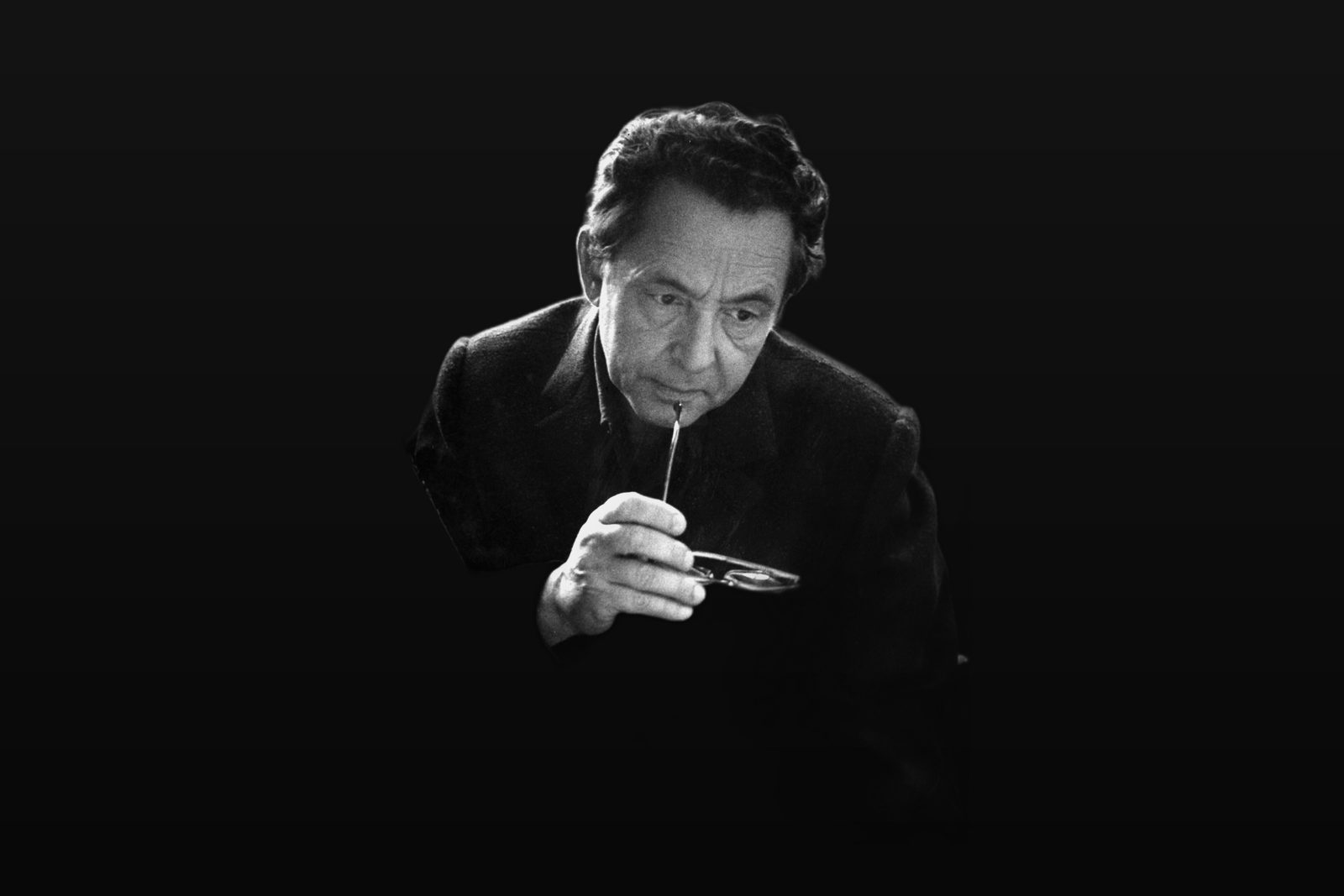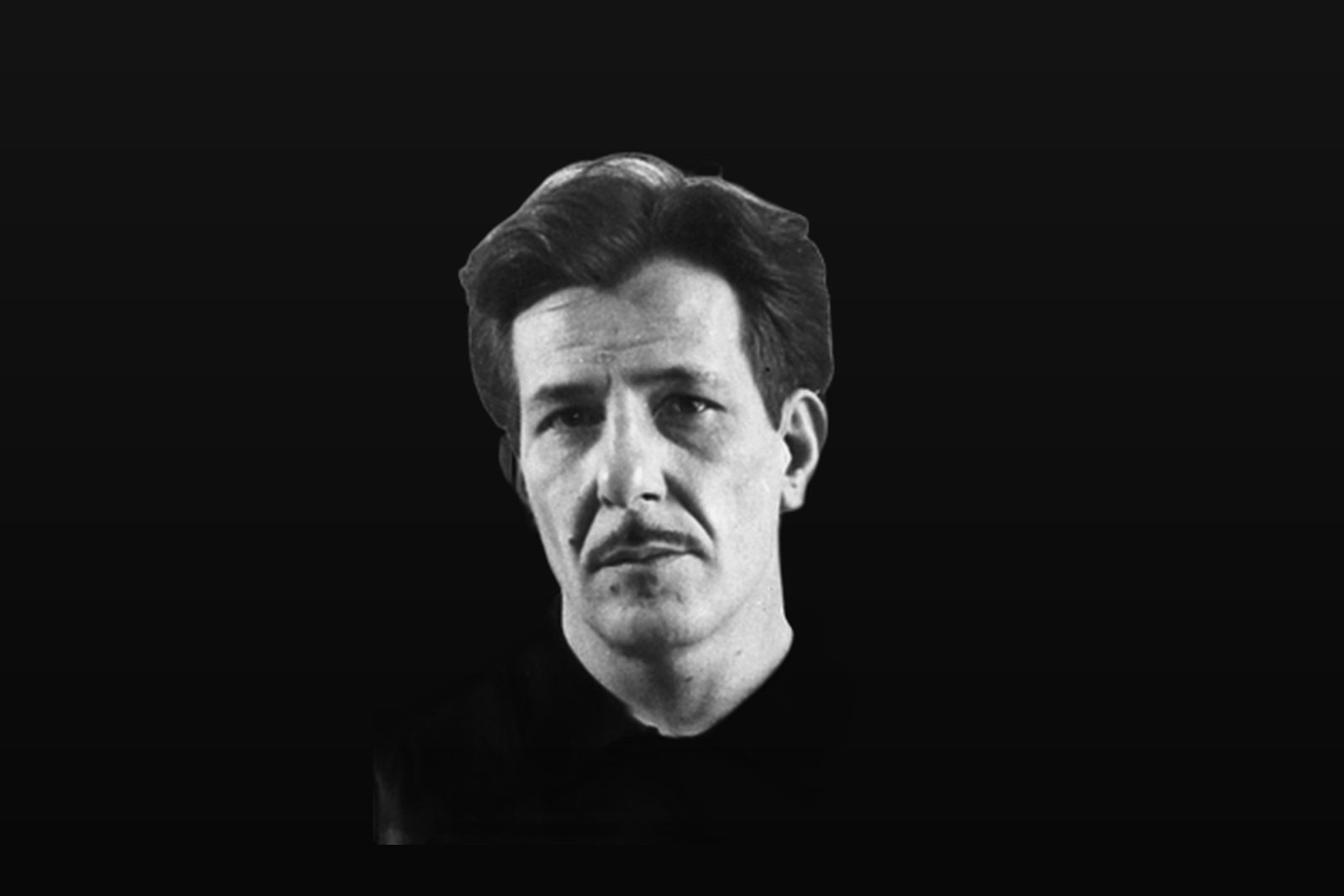
If Pierre Soulages brings to Coralie J Schmitt’s practice the matrix of outrenoir and the discipline of the few, Franz Kline (1910-1962) brings something else: the conviction that a canvas can be an architecture. Not a scene, not an emotion, not a state of mind. An architecture, that is, an assembly of masses that hold together by their own weight.
The turning point of 1950
Until 1949, Kline painted figurative urban landscapes, domestic interiors and portraits. His work was honest, without distinctive signature. It was at this time that his friend Willem de Kooning lent him a Bell-Opticon projector and showed him how the enlargement of sketches transforms a modest stroke into a plastic event. The experience was foundational.
The following year, Kline exhibited at the Egan Gallery a series of previously unseen canvases: large-format black and white works, with no apparent title or with enigmatic titles (Cardinal, Mahoning, Painting Number 2, Chief). The New York public discovered a work that simultaneously resembled Japanese calligraphy, railway engineering and abstract expressionism. It was none of these registers, and it was all three.
The canvas as construction
What distinguishes Kline from his fellow expressionists is the refusal of excess. Where Jackson Pollock saturates the canvas with drips and overlapping gestures, where Mark Rothko bathes his surfaces in vibrating colours, Kline builds. His broad black strokes are arranged like beams: they lean, cross and support each other. A Kline canvas stands upright, in the literal sense of the term.
This architectural logic traverses Schmitt’s acrylics. La ligne (60 x 90 cm, 2023) is, in its own way, a canvas-construction. The central stroke illustrates nothing: it sets down. Bataille(s) extends the reasoning with more complex masses that oppose and balance each other. And in the new 2026 series, several pieces continue this silent dialogue with Kline’s vocabulary: large black forms that structure the canvas, white that is no longer background but bearing matter.
The ethics of large format
Kline practised the large format with a particular discipline. Mahoning (1956) measures 2.03 m by 2.55 m. Cardinal (1950) reaches 2.03 m by 1.46 m. These dimensions are not a fashion effect: they correspond to the necessity of engaging the whole body in the gesture. Kline painted standing, with house painter’s brushes bought from industrial suppliers. No technical refinement. No tool coquettishness. The canvas received what the arm and shoulder could give it.
Schmitt does not yet work at these formats. Her standard remains 60 x 90 cm, occasionally 81 x 100 cm for EVOLUTION. But the underlying ethics is the same: engage the body, refuse fine-brush illustration, treat painting as physical work. This kinship of method is perhaps deeper than formal kinship.
The acknowledged divergences
As in any serious lineage, what separates must be named.
The absence of gestural signature. Kline developed a repertoire of recognisable gestures: the massive horizontal stroke, the crossroads of beams, the acute angle. Schmitt deliberately avoids this signature. Each of her pieces seeks its own tension, without motif repetition. This is an ethics of uniqueness, where Kline assumed a strong plastic identity.
The role of Far Eastern calligraphy. Critics and gallerists agree on how strongly Japanese calligraphy traverses Kline’s work, even though he denied any direct influence. Schmitt, conversely, embraces it in her Encres de Chine. The kinship with Kline then passes through acrylic, not through ink. Two mediums, two distinct lineages.
The title. Kline’s titles (Mahoning, Cardinal, Painting Number 2) are biographical or administrative. Schmitt’s (Racines, La déchirure, Tourment(s), LIBRE) are conceptual. This divergence marks a different generational belonging: Kline belongs to the New York avant-garde of the 1950s and his titles bear its trace. Schmitt belongs to a present in which the conceptual title has itself become a plastic object.
The legacy that remains
What remains, after these named divergences, is the same conviction: a black and white canvas can sustain an entire body of work. Not as a step towards colour. Not as a technical exercise. As a final position. This conviction is rare. It supposes an absolute trust in the medium and a lasting refusal of decoration.
Kline died at 51, in 1962, without ever renouncing this position. Soulages held this same position for sixty years. Schmitt inscribes herself in this lineage — not as a passive heir but as an active continuator, in a medium (acrylic) that Kline and Soulages did not use, and in an era (the present) in which fidelity to black and white must be reconquered every day against the chromatic solicitations of the day.
Sources and further reading
- Harry F. Gaugh, Franz Kline, Abbeville Press, 1985
- Franz Kline: The Vital Gesture, Whitney Museum of American Art, 1985, exhibition catalogue
- Carolyn Christov-Bakargiev, Franz Kline 1910-1962, Skira, 2004
- Robert Goldwater, “Franz Kline: Darkness Visible”, Art News, vol. 66, no. 3, May 1967