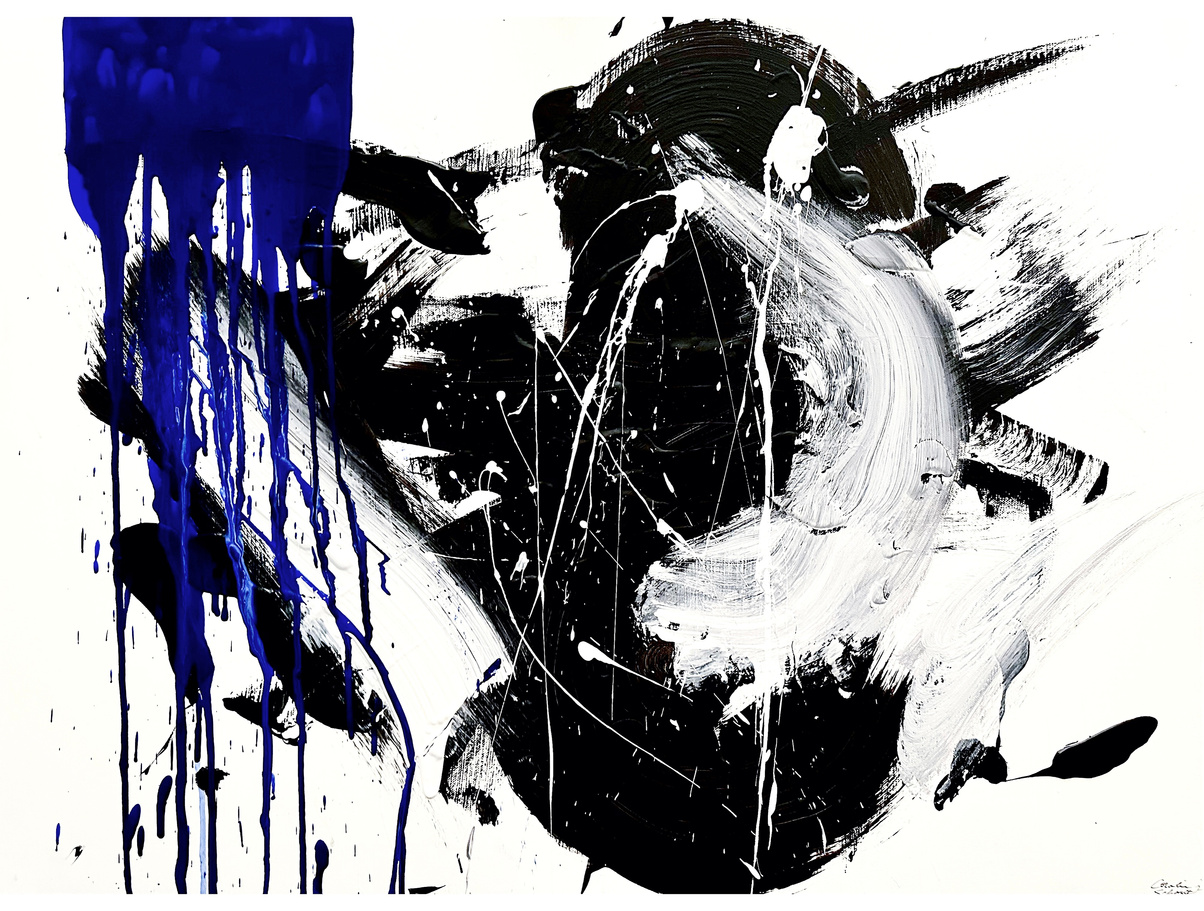
If Indian ink is the matrix of Coralie J Schmitt’s work, acrylic on canvas is its translation into the world of things. Where ink holds on the mark and the void, acrylic deploys matter. Layers, density, tension. The rigour of the irreversible stroke encounters there something it does not have in ink: the possibility of returning, of superimposing, of building over time. This possibility is not a comfort. It is another discipline.
The RACINE(S) 2025 catalogue
The RACINE(S) catalogue published in 2025 gathers sixteen pieces produced between 2023 and 2025: Illusion, La ligne, Sans titre (30 x 40), Bataille(s), Le lien, Floraison, Sans titre 2023, La déchirure, La vague, Racines, Tourment(s), LIBRE, Lumière Céleste, Sans titre 2024, Diptyque, EVOLUTION. It is an artist’s publication: a state of the production, not the catalogue of an exhibition. The titles speak. Where ink forbids itself any designation, acrylic allows itself a word. But this word remains suspended, without sentence, without demonstration. Racines. La déchirure. Tourment(s). It is naming, not illustration.
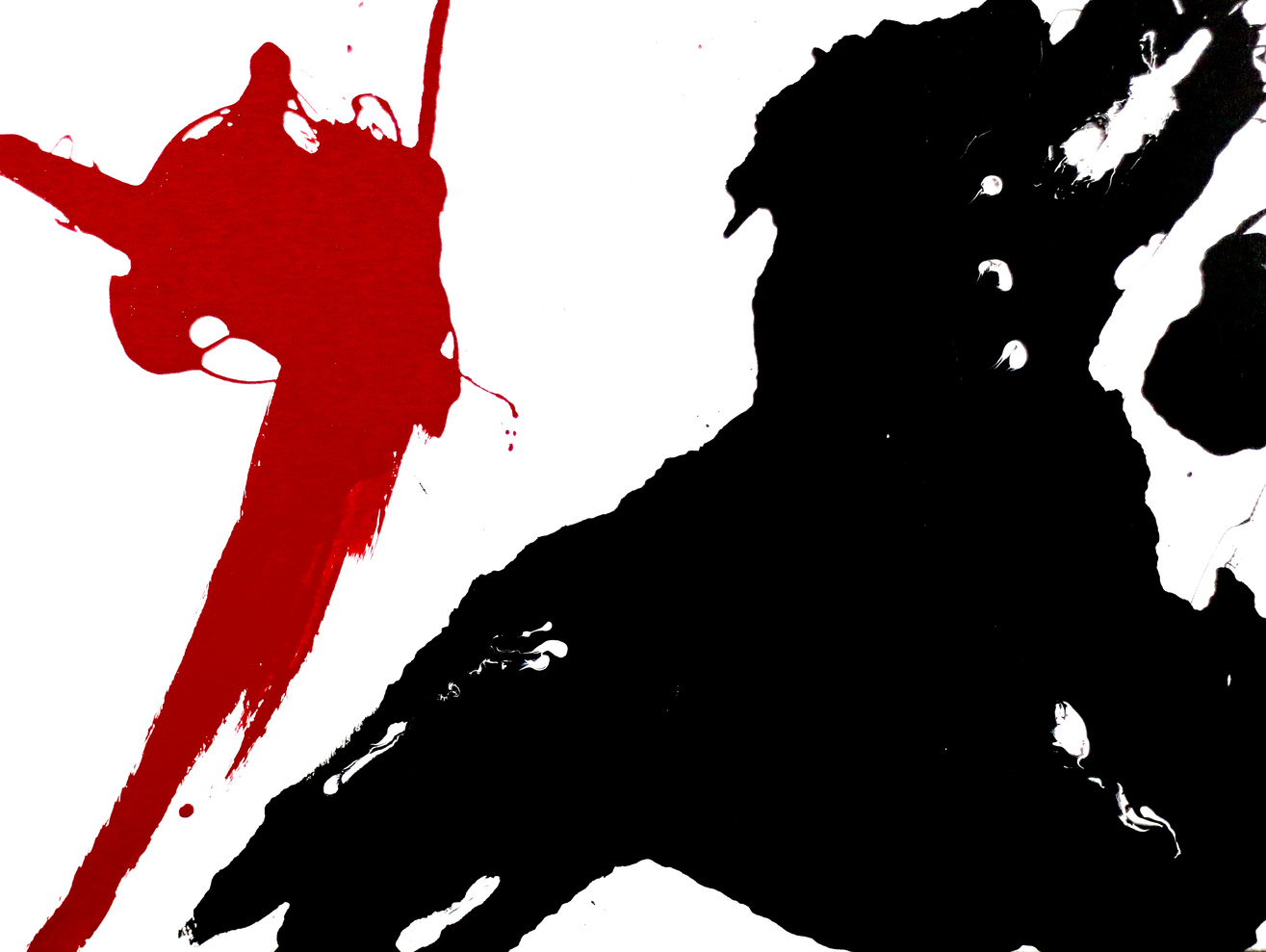
The format concentrates around a standard: 60 x 90 cm, ample enough to engage the body, contained enough to remain intimate. The smaller formats (30 x 40) welcome the pieces that seek a stronger concentration, such as Floraison or La vague. EVOLUTION (81 x 100) and Diptyque announce an appetite for more demanding formats, already prepared by the new 2026 pieces.
One lineage, three anchorages
Schmitt’s acrylic does not invent itself alone. It inscribes itself in a precise history.
Franz Kline first, for the black structure. The crossing beams of Mahoning (1956) or Painting Number 2 (1954) treat black as an architecture. The canvas becomes the plan of a building, where each mass engages the others. La ligne and Bataille(s) pursue this reasoning. The canvas does not illustrate an emotion: it lays down an apparatus.
Hans Hartung next, for contained gesturality. Hartung, unlike Pollock, never abandons control. His T series and his strokes are prepared, anticipated, then executed in a single movement. Schmitt shares this ethics: no effusion, no overflow. The gesture belongs to an overall plan.
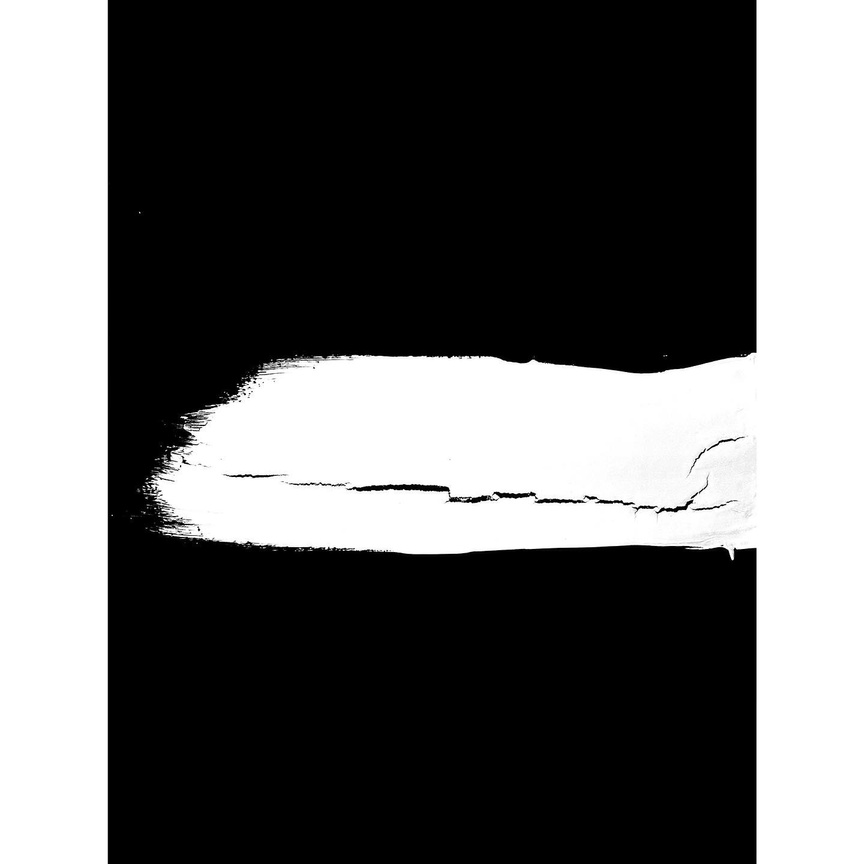
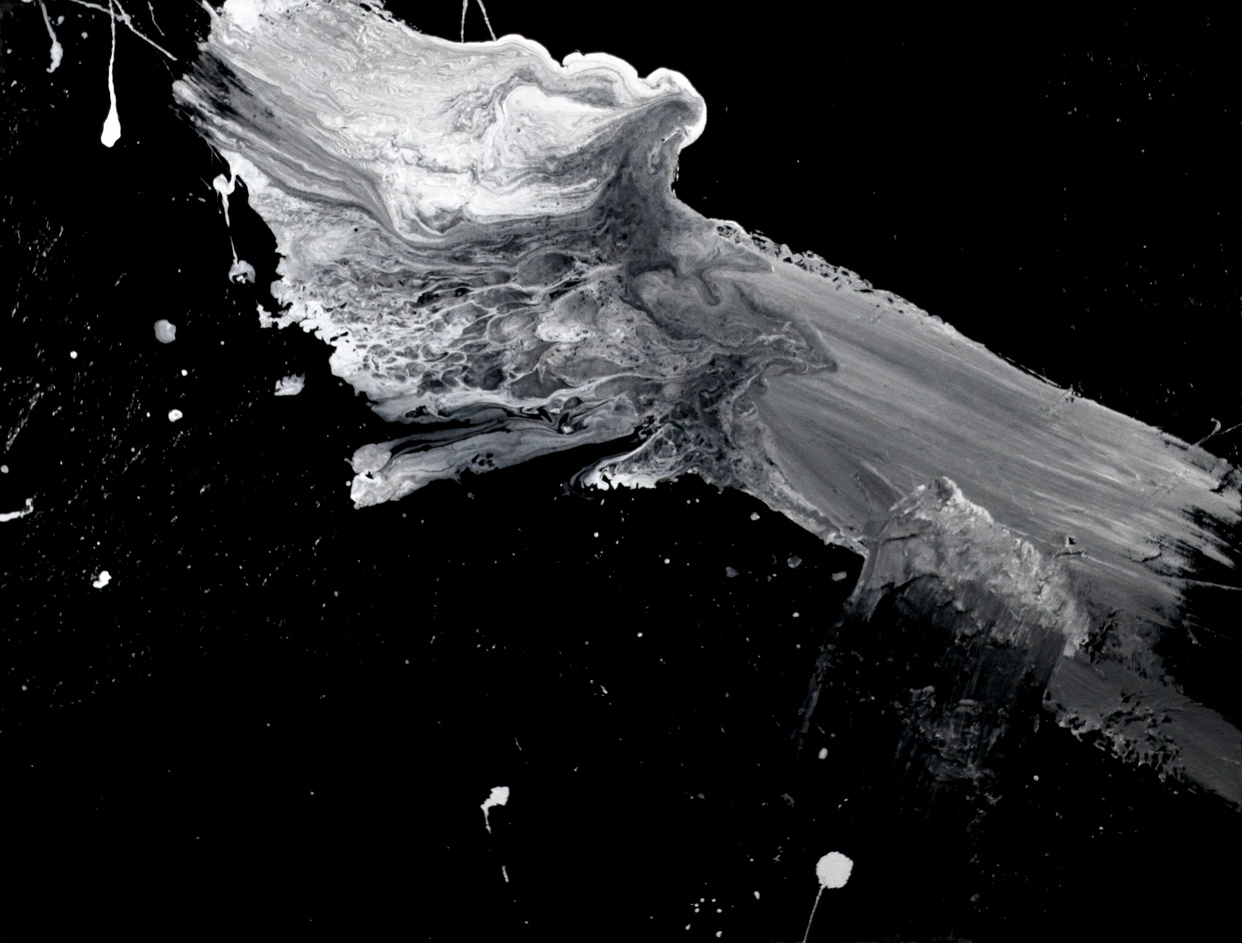
Cy Twombly finally, for density as writing. The surfaces saturated with signs of the Treatise on the Veil (1968-1970) or the Blackboard Paintings (1966-1971) show how a canvas can become a place of dense inscription without ceasing to be abstract. Tourment(s), La déchirure and certain 2026 pieces enter this territory. Matter is there traversed by scratches, drips, masses that overlap.
The new 2026 series
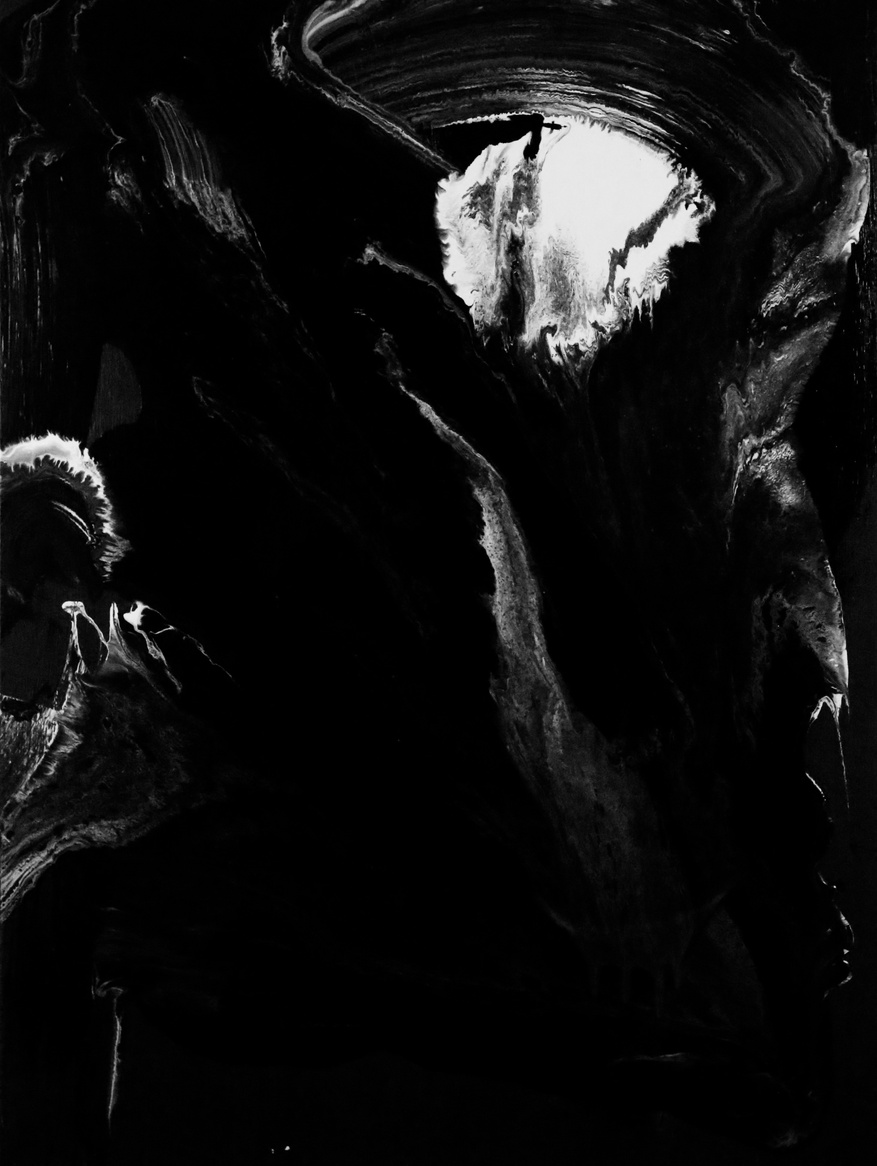
Sixteen new pieces are added in 2026 to the acrylic corpus. Medium format, constant signature: the frontal confrontation between deep black and white of strong matter. What strikes in this series is the use of white as mass. White ceases to be a background to become an actor. It bears, it pushes, it superimposes itself. This inversion of the traditional hierarchy (black as mark, white as support) brings Schmitt closer to another lineage: Robert Ryman and his white monochrome paintings, Pierre Soulages in his founding gesture of inversion (black reflecting light).
The architecture of contrast
Schmitt’s manifesto speaks of contrast as a founding principle. This formula is not a poetic metaphor: it is a precise plastic programme. Contrast, in this acceptance, is not the graphic opposition between two values. It is a structural tension. Between density and effacement. Between mass and void. Between what imposes itself and what effaces itself.
This is what differentiates Schmitt’s acrylic from that of most of her contemporaries. Where a Tracey Emin or a Hurvin Anderson assume colour, figure or autobiography, Schmitt seeks a necessary abstraction. The manifesto says it: nothing is decorative, everything is necessary. Each piece must be able to justify its own existence without the help of a narration, a seductive colour, a recognisable figure.
It is a formidable requirement, which excludes almost everything. What remains, after this exclusion, is what is seen on the canvases: the minimal plastic decision that stands upright. The right form.
Recommended reading
- Pierre Soulages, catalogue Soulages au Louvre, Musée du Louvre Éditions, 2019
- Yve-Alain Bois, Painting as Model, MIT Press, 1990
- Cy Twombly, catalogue Cy Twombly (Centre Pompidou, 2016-2017)
- Rosalind Krauss, L’inconscient optique, Au même titre, 2002